How to Write a LinkedIn Summary That Gets Recruiters to Message You in 2026
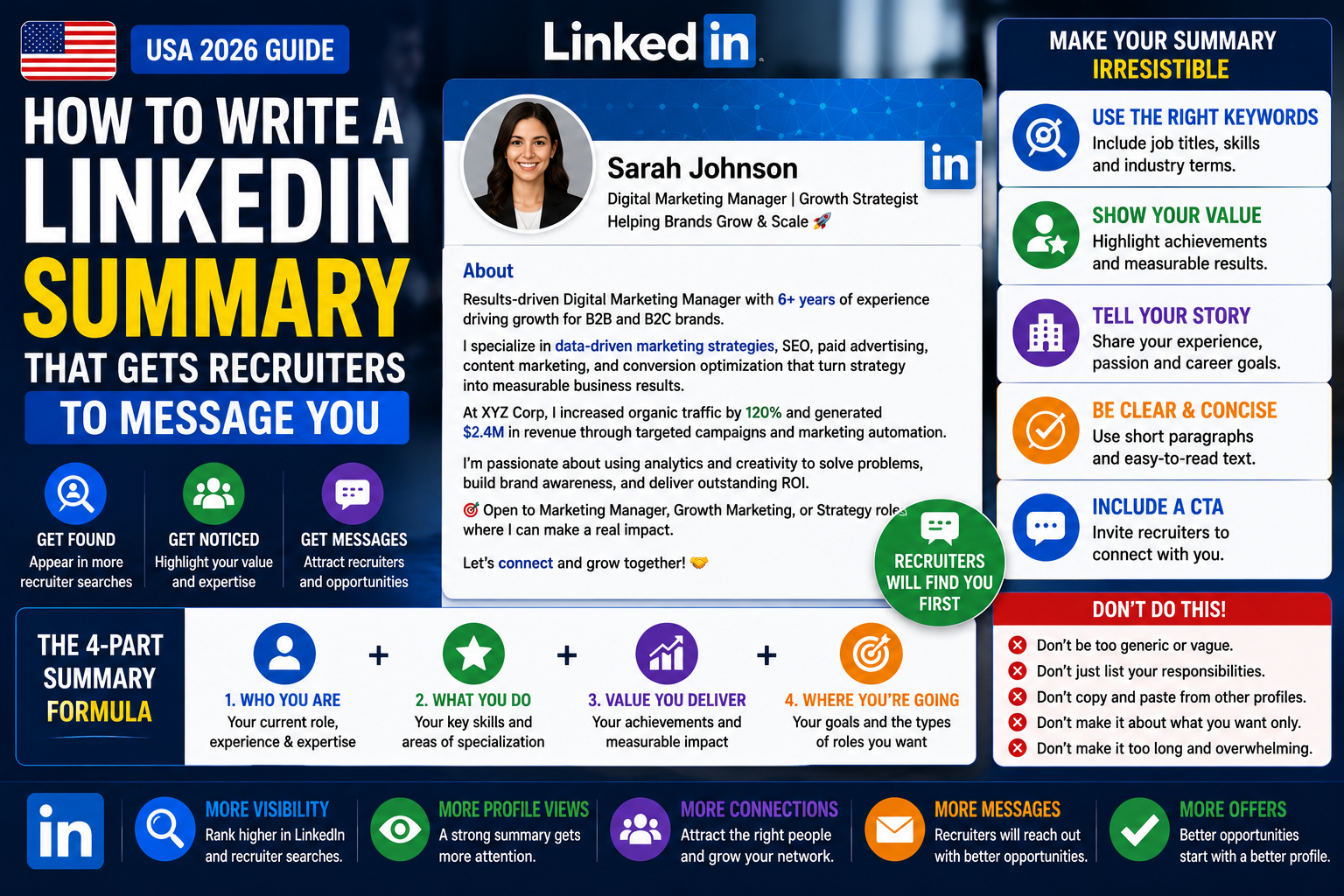
Most LinkedIn profiles have an empty About section – or worse, a copy-paste of their resume. Your LinkedIn summary is 2,600 characters of open space where you can tell your professional story, show personality, include keywords that get you found, and give a recruiter or hiring manager a reason to reach out. This guide walks you through exactly how to fill that space in a way that works – with a proven structure, real examples by job type, and the exact mistakes that make hiring managers stop reading.
What Is a LinkedIn Summary and Why It Matters
Your LinkedIn summary is the “About” section on your profile – the open text field that appears just below your headline and profile photo. LinkedIn gives you up to 2,600 characters to use however you want. Most people use about 300. Most of those 300 are wasted on generic phrases that tell a recruiter nothing useful.
Here’s why it matters: when a recruiter clicks your profile after finding you in a search, your summary is the first thing they read in depth. Your headline got them to click. Your summary convinces them to message you – or move on to the next profile. It’s the difference between a profile that generates inbound interest and one that just exists.
LinkedIn’s algorithm indexes your summary text for search. Keywords that appear in your About section count toward recruiter search rankings – though not as heavily as your headline and job titles. A summary packed with relevant, naturally written skills and role titles improves the chances your profile surfaces when recruiters are searching for candidates like you.
Beyond search, your summary does something your resume can’t: it lets you write in a human voice. A resume is a formatted list of achievements. A summary is a narrative. Recruiters and hiring managers read hundreds of resumes – a summary written with a genuine, direct tone sticks out because most don’t have one.
LinkedIn Summary vs LinkedIn Headline
These two sections work as a team, not duplicates of each other. Here’s how they divide the work:
- LinkedIn Headline (220 characters): Your job title, key skills, and certifications. Optimized for search. Keyword-dense. Shows in every search result, comment, and connection preview. It’s a label.
- LinkedIn Summary (2,600 characters): Your professional story, context, accomplishments, and personality. Optimized for conversion – turning a profile view into a recruiter message or a connection. It’s a pitch.
If your headline says “Senior Financial Analyst | FP&A | Excel | Power BI | Healthcare Finance,” your summary shouldn’t just repeat those four words. It should explain what you’ve actually done with those skills, what kind of problems you solve, and what kind of opportunity you’re looking for next.
If you haven’t nailed your LinkedIn headline yet, start there before writing your summary. A strong headline gets people to your profile – then the summary does the rest. Use the LinkedIn Headline Generator to build a keyword-rich headline, then come back here to write the summary that backs it up.
The 2,600-Character Limit: How to Think About Space
LinkedIn shows only the first 300 characters of your summary before cutting off with a “see more” link. That means your opening three sentences are the most critical – they determine whether someone clicks “see more” or scrolls past.
Here’s a practical way to break up your character budget:
- First 300 characters – The hook: One to two sentences that immediately communicate who you are and what you do. Make this interesting enough that they click “see more.”
- 300-1,000 characters – The substance: Your experience, specialties, and one or two concrete achievements with numbers.
- 1,000-1,800 characters – The context: Industries you’ve worked in, types of problems you solve, what kind of work energizes you.
- 1,800-2,200 characters – The keywords: A brief “Specialties” or “Skills” line with 10-15 keywords written naturally into a few sentences or a clean list.
- Final 200-300 characters – The call to action: Tell people how to reach you and what kind of opportunity or conversation you’re open to.
Always write your LinkedIn summary in first person – “I lead teams,” “I specialize in,” not “John is a results-driven professional who…” Third-person bios are appropriate for press releases and author bios, not LinkedIn profiles. First person is warmer, more direct, and reads as more authentic to US hiring managers.
The 4-Part Formula for a Strong Summary
Use this structure as your starting point for any LinkedIn summary, regardless of industry or career stage.
4-Part LinkedIn Summary Formula
💡 Formula in Action – Before and After
Before (generic, no structure):
“Experienced marketing professional with a passion for driving results. Skilled in digital marketing, social media, SEO, and content creation. Looking for new opportunities in a fast-paced environment.”
After (4-part formula applied):
“I build demand generation programs for B2B SaaS companies – the kind that fill pipelines, not just spreadsheets. I’ve spent six years running content and paid acquisition at companies ranging from 20-person startups to 500-person growth-stage firms.
My core work is turning organic search and paid channels into measurable revenue pipeline. At my last company, a 14-person fintech startup in Austin, I grew inbound leads from 300 to 2,100 per month over 18 months with a team of two. Tools I work in daily: HubSpot, Semrush, Google Ads, Looker.
What I care about is building things that last after I leave – not campaigns, but systems. I’m currently open to senior marketing roles at B2B SaaS companies in the $5M-$50M ARR range. Reach me at jsmith@email.com or send a connection request with a note.”
✍️ Build Your LinkedIn Summary in Minutes
Use the USAJobsKit LinkedIn Summary Generator to write a professional, keyword-rich About section without starting from a blank page.
Use Free LinkedIn Summary Generator →Full LinkedIn Summary Examples by Job Type
These are complete, ready-to-adapt summaries for common US jobs. Each one follows the 4-part formula, is written in first person, and includes specific details that make it credible and searchable.
Registered Nurse – Job Seeker
I’m a Registered Nurse with six years of critical care experience across Level I trauma centers in the Dallas-Fort Worth area. I hold my CCRN certification and have worked in both medical ICU and cardiac ICU settings, with a patient caseload of six to eight per shift.
My strongest areas are rapid assessment, ventilator management, and charge nurse coverage. I led a quality improvement initiative at Parkland Memorial that reduced catheter-associated UTI rates by 31% over one quarter – an initiative that became part of our unit’s standard protocol. I’m experienced in Epic EHR and cross-trained in CVICU and MICU workflows.
What I love about critical care is the precision it demands. There’s no room for guesswork, and I’ve built my career around being the nurse other nurses want on their shift.
I’m currently exploring cardiac ICU and flight nurse opportunities in the DFW and Austin markets. Reach me at m.gonzalez@email.com or connect here on LinkedIn.
Software Engineer – Active Job Search
I’m a full stack software engineer with five years of experience building scalable web applications for SaaS companies. My primary stack is Python (Django/FastAPI) and React, deployed on AWS. I’ve worked on teams ranging from three engineers to 60.
Most of my career has been on the backend side – API architecture, database optimization, and building the infrastructure that keeps high-traffic systems fast. At my last company, I led a backend refactor that cut average API response time from 900ms to 140ms and reduced infrastructure costs by 22%. I’ve also built and owned three public-facing APIs that now process over 400,000 requests per day.
I’m drawn to technically interesting problems – specifically the kind where performance and scale come into conflict and there’s no clean off-the-shelf answer. I write clean, well-documented code and take ownership of what I ship.
Currently open to senior or staff engineer roles at product-focused companies, remote preferred. Connect here or reach me at dev.jsmith@email.com.
High School Teacher – Building Professional Network
I’ve been teaching high school math in Gwinnett County, Georgia for eight years, primarily Algebra II and Pre-Calculus at the 10th and 11th grade level. My students consistently outperform the county average on end-of-course assessments – a gap I’ve worked hard to close through differentiated instruction and a lot of after-school time.
I specialize in reaching students who have been labeled “not math people.” My classroom model uses project-based assessments alongside traditional testing, and I’ve found it particularly effective with students who have test anxiety or IEPs. Over the past three years, the percentage of my students scoring “Meets” or “Exceeds” on the Georgia Milestones has gone from 61% to 83%.
I’m currently pursuing my EdS in Curriculum and Instruction and thinking about what the next chapter looks like – whether that’s instructional coaching, curriculum design, or department leadership.
I’m happy to connect with other Georgia educators, curriculum developers, or EdTech companies building tools for secondary math. Find me here or at j.washington@email.com.
Account Executive – Actively Recruiting
I sell HR and workforce management software to mid-market companies – the 200 to 2,000 employee range where HR teams are finally big enough to need real tools but often still running on spreadsheets. I’ve been in this segment for four years and I know the buyer, the objections, and the deal dynamics well.
Last year I finished at 138% of quota with an average deal size of $94,000 and an average sales cycle of 87 days. I run a consultative, multi-threading process – I don’t pitch to one contact and hope for the best. My close rate on Stage 3+ opportunities is consistently above 40%. I work primarily in Salesforce and use Gong and Outreach daily.
What I find genuinely interesting about this space is that the buying committee is emotional – HR leaders are staking their reputation on the tools they bring in. I like selling something that matters to the people buying it.
Open to Account Executive or Senior AE roles at HR tech, payroll, or workforce management companies. Base + commission roles in the $120K-$160K OTE range. Reach me at m.chen@email.com.
Recent Graduate – Entry Level
I graduated from the University of Texas at Austin in May 2026 with a degree in Advertising and a concentration in digital marketing. During college I completed two internships – one at a local social media agency and one in-house at a consumer brand with 85,000 Instagram followers.
At my in-house internship, I took over management of the brand’s organic Instagram and TikTok accounts for four months. In that time, the Instagram account grew from 85,000 to 102,000 followers, and one TikTok I produced organically reached 340,000 views. I’m comfortable in Canva, Adobe Premiere, Hootsuite, and Google Analytics.
I care a lot about brand voice – how a brand sounds across every platform and why consistency there actually builds trust with an audience. That’s the direction I want to grow in.
I’m currently seeking entry-level marketing coordinator or social media roles in Austin. Open to in-person or hybrid. Connect here or reach me at tlopez@email.com.
Adding Keywords Without Sounding Robotic
Keywords make your summary searchable. But a wall of comma-separated skills at the end of your summary looks like it was written for a bot, not a person – and it reads that way too. Here’s how to include the keywords you need while keeping the text human.
Weave Keywords Into Sentences
Instead of listing “HubSpot, Salesforce, Pardot, Google Ads, SEO, content marketing” as a bullet-point dump, write: “My day-to-day work lives in HubSpot and Salesforce, and I run paid acquisition through Google Ads and Meta – usually alongside an organic content and SEO program.” Same keywords, more readable, and it gives context for how you actually use them.
Add a Specialties Line at the End
Many strong LinkedIn profiles end their summary with a line like: “Specialties: Financial modeling, FP&A, Excel, Power BI, SQL, budget forecasting, variance analysis, healthcare finance, SaaS metrics.” This is a clean, low-friction way to pack in additional keywords that didn’t fit naturally into your narrative. It signals to both recruiters and the LinkedIn algorithm that these are genuine skills, not fluff.
Use Job Posting Language as Your Guide
Open five to eight job postings for roles you’re targeting. Note the words they use for your job title, the tools they mention, and the responsibilities they describe. Work those exact phrases into your summary. LinkedIn search is keyword-based – if recruiters are typing “Epic EHR nurse ICU” and those words are in your summary, you show up. If they’re not, you don’t.
Use the Job Description Keyword Finder on USAJobsKit to pull the most important terms from any job posting in seconds. Use those same keywords in both your LinkedIn summary and your resume for maximum alignment with what recruiters are searching for.
Adjusting by Career Stage
The 4-part formula stays the same, but the emphasis shifts depending on where you are in your career.
Students and Recent Graduates
You don’t have years of experience to anchor your summary – so lead with your degree, concentration, and one or two internship or project results. Show initiative. Mention the specific tools you’ve used and the type of role you’re targeting clearly. Recruiters won’t hold your experience level against you if you show you know what you want and have done real work.
Mid-Career Professionals (5-15 years)
This is the most common and the most competitive LinkedIn user group. Your summary needs to be specific enough to stand out from thousands of people with similar titles. Lead with your specialty or niche, not just your job category. A “marketing manager” summary is forgettable. A “demand generation manager who builds pipeline for B2B SaaS companies at the Series A to Series B stage” is memorable and searchable.
Senior and Executive Level
At the senior level, your summary should communicate leadership scope, business impact, and strategic perspective. Talk about teams led, P&L responsibility, business transformations, or enterprise-level results. Executives who write vague summaries (“20 years of experience driving growth across industries”) blend into the crowd. One strong, specific result per major role area does more work than five general claims.
Career Changers
Your summary is your best opportunity to frame the transition before anyone else does. Acknowledge the shift briefly – one sentence is enough – then immediately pivot to what your previous experience brings to the new direction. What skills transfer? What perspective do you have that someone who came up through the traditional path doesn’t? Lead with that.
Freelancers and Consultants
Your summary should read like a brief pitch to potential clients. What do you do, for whom, and what results do you get? Include the types of projects you take on, your typical engagement size or scope, and how to hire you. End with a direct call to action – not “feel free to connect,” but “reach me at X for project inquiries.”
Common Mistakes That Kill Your Summary
Mistake 1 – Leaving It Blank
An empty About section tells recruiters you’re either not serious about your LinkedIn presence or you couldn’t be bothered. Either interpretation hurts you. Even a three-sentence summary is better than nothing – it gives the algorithm something to index and the reader something to react to.
Mistake 2 – Copying Your Resume Word for Word
Your summary and resume serve different purposes. A resume lists achievements in bullet format. A summary tells a story in paragraphs. If your About section reads like a list of job responsibilities, rewrite it in full sentences and add context: why did you make each move? What were you trying to build? What problems did you solve?
❌ Resume Dump
“- 8 years of experience in supply chain management. – Managed vendor relationships. – Oversaw logistics operations. – Reduced costs. – Led team of 12.”
✅ Narrative Summary
“I’ve spent eight years in supply chain management, primarily in consumer goods manufacturing. My core work is building the vendor and logistics infrastructure that cuts fulfillment costs without sacrificing reliability. At my current company, I restructured 14 supplier contracts and reduced cost-per-unit by 17% over two years.”
Mistake 3 – Starting With “I Am a Passionate…”
The word “passionate” shows up in roughly one in four LinkedIn summaries. It’s the single most overused word on the platform. Starting your summary with a claim about your personality – “passionate,” “dedicated,” “motivated,” “driven” – wastes your most valuable real estate. Start with what you do and what you’ve accomplished. Let the reader form their own impression of your character.
Mistake 4 – No Call to Action
Many strong summaries end with the last achievement or result and then just… stop. A call to action takes two sentences and makes a real difference. Tell the reader what you’re open to and how to reach you. If you don’t make it easy for someone to contact you, most won’t bother to hunt for your email.
Mistake 5 – Never Updating It
Your LinkedIn summary should be a living document. Any time you take on a significant new project, earn a new certification, hit a notable result, or change your career direction, update your summary. A summary that still describes your role from three years ago – or worse, your goals from when you were job searching in 2022 – signals a profile that isn’t actively maintained. Recruiters notice.
✅ Key Takeaways
- Your LinkedIn summary is the About section – up to 2,600 characters you control completely
- Only the first 300 characters show before “see more” – make your opening two sentences compelling enough to earn that click
- Always write in first person – not “John is a…” but “I specialize in…”
- Use the 4-part formula: hook, work experience with results, your “why,” and a call to action with contact info
- Include keywords naturally throughout the text – don’t dump a skill list at the bottom
- Add a “Specialties” line at the end for additional keyword coverage without cluttering the narrative
- Adjust the emphasis based on career stage – students lead with potential, mid-career professionals lead with specialty, executives lead with impact
- Update your summary every time your career direction, role, or key achievements change