How to Answer Why Should We Hire You? in 2026
Quick Answer
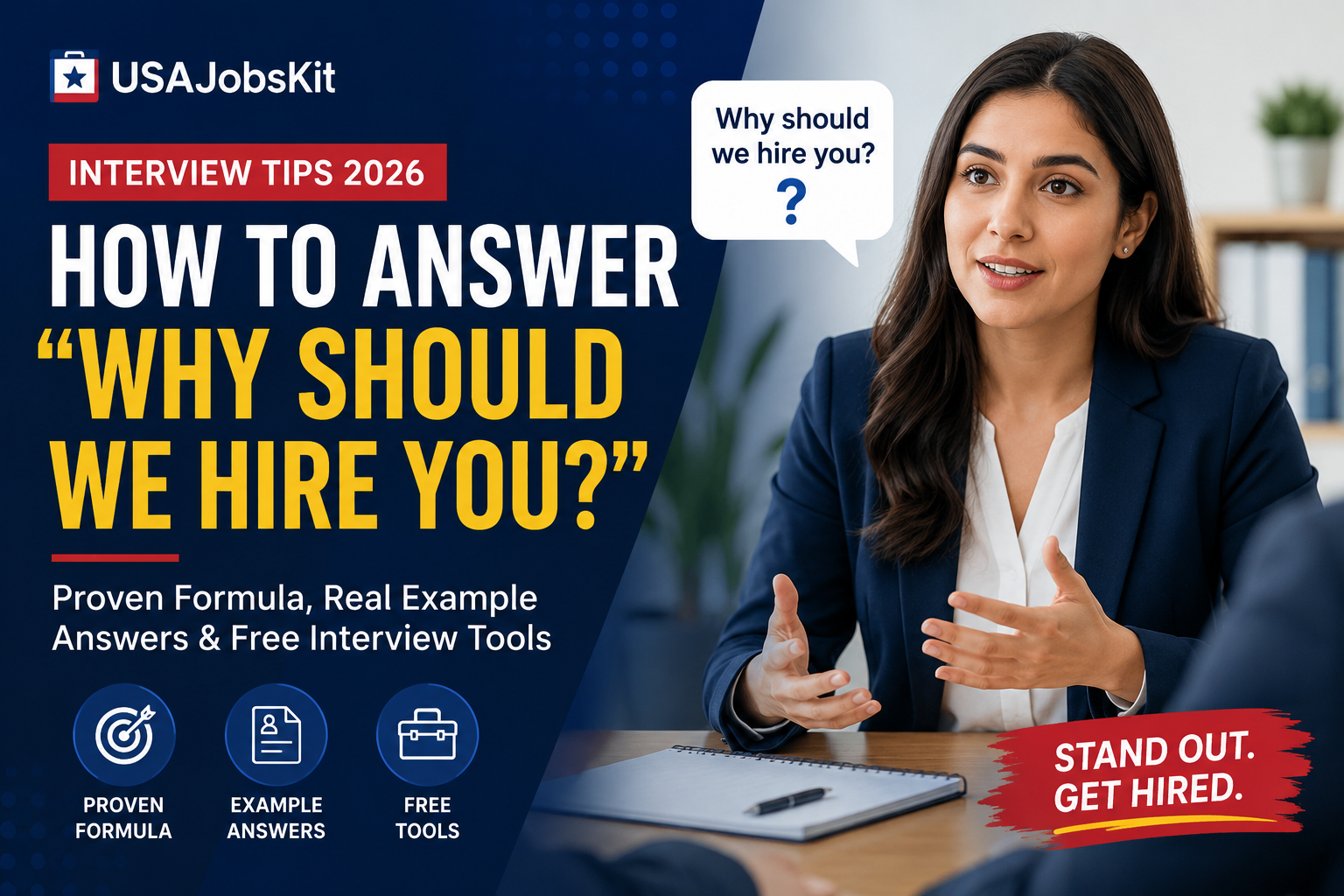
The strongest answer connects your specific skills and a brief real world example directly to what the job needs. Avoid generic claims like “I’m a hard worker.” Instead, pick one or two strengths that match the role, back them with a result, and explain how that helps the employer. If you want to build and practice your answer, use the STAR interview answer builder or the tell me about yourself generator to sharpen your delivery.
“Why should we hire you?” tends to show up near the end of an interview, right when you are most tired and most tempted to say something vague. That timing is not an accident. Interviewers use it as a final check on whether you actually understand the role and can make a clear case for yourself.
This guide breaks down exactly what the question is asking, how to build a strong answer using a simple three part formula, and what sample answers look like across different job types. It also covers the mistakes that sink otherwise good candidates.
What the question is really asking
Most candidates hear “Why should we hire you?” and start listing every positive trait they can think of. That approach usually produces a forgettable answer. The interviewer is not asking you to summarize your resume. They are asking: of all the people we could pick, why does choosing you make sense for this specific role?
That shift matters. A strong answer is focused on the employer’s problem, not just your qualities. It shows you read the job description, understand what success looks like in the role, and can connect your background to that outcome. That combination is what separates a confident answer from a rambling one.
Key mindset: Think of this as a 60-second closing argument. You are not listing everything good about you. You are making the clearest possible case for why hiring you solves their problem.
The three part formula
A practical way to build this answer is to cover three things in order: your strongest relevant skill, a brief example that proves it, and a direct statement of how that skill helps the employer.
Part 1: Name your strongest relevant strength
Pick one or two skills that match the job requirements most closely. Do not try to mention everything. The more focused your answer, the more confident it sounds. If the job description emphasizes project management and cross-team coordination, lead with that, not a general claim about work ethic.
Part 2: Back it up with a brief example
One sentence with a real result is worth more than three sentences of self-description. You do not need the full STAR format here, but grounding your claim in something that actually happened makes it credible. Numbers help when you have them. “I reduced onboarding time by 30%” lands harder than “I improved processes.” If you want to build out full STAR-format examples for other questions, the STAR interview answer builder is a good starting point.
Part 3: Connect it to what they need
Close the loop explicitly. Tell the interviewer how your strength and experience translates to value in this role. Something like “That’s why I think I can step in and contribute quickly here” ties your answer back to their decision without sounding scripted.
Target length: 60 to 90 seconds out loud. That is roughly three to five sentences. Anything longer risks losing the interviewer’s attention.
What to include and what to skip
| Include this | Skip this |
|---|---|
| One or two specific skills tied to the job description | A full list of every trait you have |
| A brief real example with a measurable result if possible | Generic statements like “I’m a fast learner” with nothing behind them |
| A closing line connecting your strength to their role | Personal stories that are not relevant to the position |
| Confidence and directness in delivery | Apologies, hedging, or starting with “I’m not sure but…” |
| Answers focused on employer value | Answers focused only on what you want |
Sample answers for different situations
Entry-level candidate with limited experience
“I may not have years of experience in this field, but I spent the last year building real skills in data analysis through coursework and a capstone project where I identified a $12,000 inventory gap for a local business. I’m focused, I learn processes quickly, and I’m specifically interested in this role because it matches the direction I’ve been preparing for.”
This answer is honest about the experience gap but still makes a concrete case. It uses a real project result instead of vague claims about potential.
Mid-career professional switching industries
“The skills I’ve built in operations management transfer directly to what you’re describing here. In my last role, I took a team that was missing 40% of its weekly targets and got them to consistent on-time delivery in under four months by restructuring how work was assigned and tracked. That same approach to process and accountability is exactly what this role calls for.”
Career switchers often undersell themselves by over-apologizing for what they lack. This answer leads with the transferable result and frames the switch as a strength.
Experienced candidate with deep technical skills
“I’ve spent eight years in network security, the last three specifically in cloud infrastructure, which is exactly where your job description is focused. At my current company, I led a migration that cut security incidents by 60% over 18 months. I know this space, I know the common failure points, and I’m ready to bring that to a team that’s growing fast.”
For technical roles, specificity is everything. Naming the exact area of expertise and a clear outcome does more work than any amount of general praise.
Candidate returning to work after a gap
“I took time away to handle a family situation, and during that time I kept current by completing two certifications in project management. I’m returning with a clear focus and a genuine motivation to contribute. The skills I built before my break are still very relevant here, and I’m ready to apply them immediately.”
Be brief about the gap, do not over-explain it, and pivot quickly to what you bring. If you also need to sharpen how you introduce yourself before this question comes up, the tell me about yourself generator can help you frame the full arc of your story.
How to prepare before the interview
Preparation for this question starts with the job description. Print it out or open it on a second screen and mark the skills and responsibilities that appear more than once. Those are the employer’s priorities, and your answer should address at least one of them directly.
Next, write down two or three accomplishments from your work history that connect to those priorities. Pick examples that have a result you can state briefly. Then practice out loud until the answer sounds natural, not rehearsed. Recording yourself on your phone for 60 seconds is one of the fastest ways to catch filler words, hedging phrases, or answers that run too long.
- Read the job description carefully. Identify the two or three skills the employer emphasizes most.
- Match your strongest examples to those skills. One example per skill point is enough.
- Practice out loud, not just in your head. The answer needs to flow naturally at speaking speed.
- Prepare for follow-up questions. If your example is strong, the interviewer will likely ask for more detail.
- Know your numbers. Results with specific figures are harder to dismiss than vague descriptions.
Common mistakes to avoid
- Starting with “I’m a hard worker.” Every candidate says this. It signals nothing specific and wastes your opening sentence.
- Reciting your entire resume. The interviewer already has it. Your answer should add something the resume cannot show on its own.
- Talking only about what you want. This question is about their needs. Answers that focus on your career growth or salary expectations miss the point entirely.
- Being too humble. Saying “I’m not sure if I’m the best fit but…” undercuts everything that follows. Be direct.
- Going over two minutes. Long answers signal that you cannot prioritize. If you are past 90 seconds, trim the example or cut one of your points.
- Using the same answer for every job. A generic answer is easy to spot. Tailor at least the skills and the closing line to the specific role.
Quick test: Read your answer back and ask: does this only work for this job, or could it apply to any job anywhere? If the answer is “any job,” it needs to be more specific.
USAJobsKit tools that help
Building a strong “Why should we hire you?” answer requires more than just confidence. It also means having a clear picture of your own strengths, a polished resume that backs them up, and the ability to talk about your career story smoothly from the start of the interview.
STAR Interview Answer Builder
Build structured answers for behavioral questions using the Situation, Task, Action, Result format.
Open the STAR answer builderTell Me About Yourself Generator
Draft a clear, focused self-introduction that sets up the rest of the interview well.
Open the generatorResume Accomplishments Generator
Find the right language for your work history so your examples are ready before the interview starts.
Open the accomplishments generatorResume Keywords Generator
Match your resume language to the job description before you walk in the door.
Open the keywords generatorRelated reading on USAJobsKit
- How to answer “Tell me about yourself” – the question that usually comes right before this one
- How to negotiate your salary – what to do after you get the offer
- How to set your salary range – so you are ready if pay comes up in the interview
- How much should you earn – understanding your market value before you walk in
FAQ
What is the best way to answer “Why should we hire you?”
The strongest answers connect your specific skills and accomplishments directly to what the job requires. Lead with one or two concrete strengths, back them up with a brief example, and tie it to how you will help the employer. Avoid generic traits like “I’m a team player” unless you immediately follow with proof.
How long should my answer be?
Aim for 60 to 90 seconds when speaking out loud. That is roughly three to five sentences covering your key strength, a brief example, and a direct connection to the role. Going longer usually means you are including details the interviewer did not need.
Should I mention salary when answering this question?
No. This question is about your fit and value to the employer, not compensation. Salary conversations belong in a separate part of the process. If you want to prepare for that conversation separately, check the salary negotiation guide.
Can I use the STAR method here?
Yes, a shortened STAR structure works well. You do not need the full format, but grounding your answer in a real situation and a specific result makes it far more convincing than a list of adjectives. The STAR interview answer builder can help you structure the example part of your answer.
What if I have no direct experience for the role?
Focus on transferable skills, relevant coursework, personal projects, or volunteer work. Be direct about where you are in your career and explain clearly why this specific role is the right next step. Avoid apologizing for the gap. Confidence in your transferable strengths matters more than years of exact experience.
Is it okay to mention competing offers when answering this question?
Generally no. The question is about your value to them, not your market demand. Mentioning other offers at this stage can distract from your answer and shift the tone of the conversation. If you want to use competing offers strategically, that discussion fits better during salary negotiation.
Sources
- Harvard Business Review – How to Answer “Why Should We Hire You?” in an Interview
- Indeed Career Advice – Interview Q&A: “Why Should We Hire You?”
- University of Hawaii Career Center – How to Answer: Why Should We Hire You?
Final takeaway
“Why should we hire you?” is the one question in every interview where you get to make a direct, uninterrupted case for yourself. A focused answer that connects your real strengths to the employer’s actual needs will always outperform a longer answer that tries to cover everything.
Prepare your answer using the job description, anchor it to a specific result, and keep it under 90 seconds. For help building the supporting pieces, the interview tools and resume tools on USAJobsKit are built for exactly this kind of preparation.
Prepare your interview answers now
Build structured, confident answers before you walk into the room.
Disclaimer: This article is for general educational and career guidance purposes only. Interview practices, hiring standards, and employer expectations vary by industry, company, and role. The examples and advice here are illustrative, not guarantees of any particular outcome. Always research the specific employer and role before your interview.