
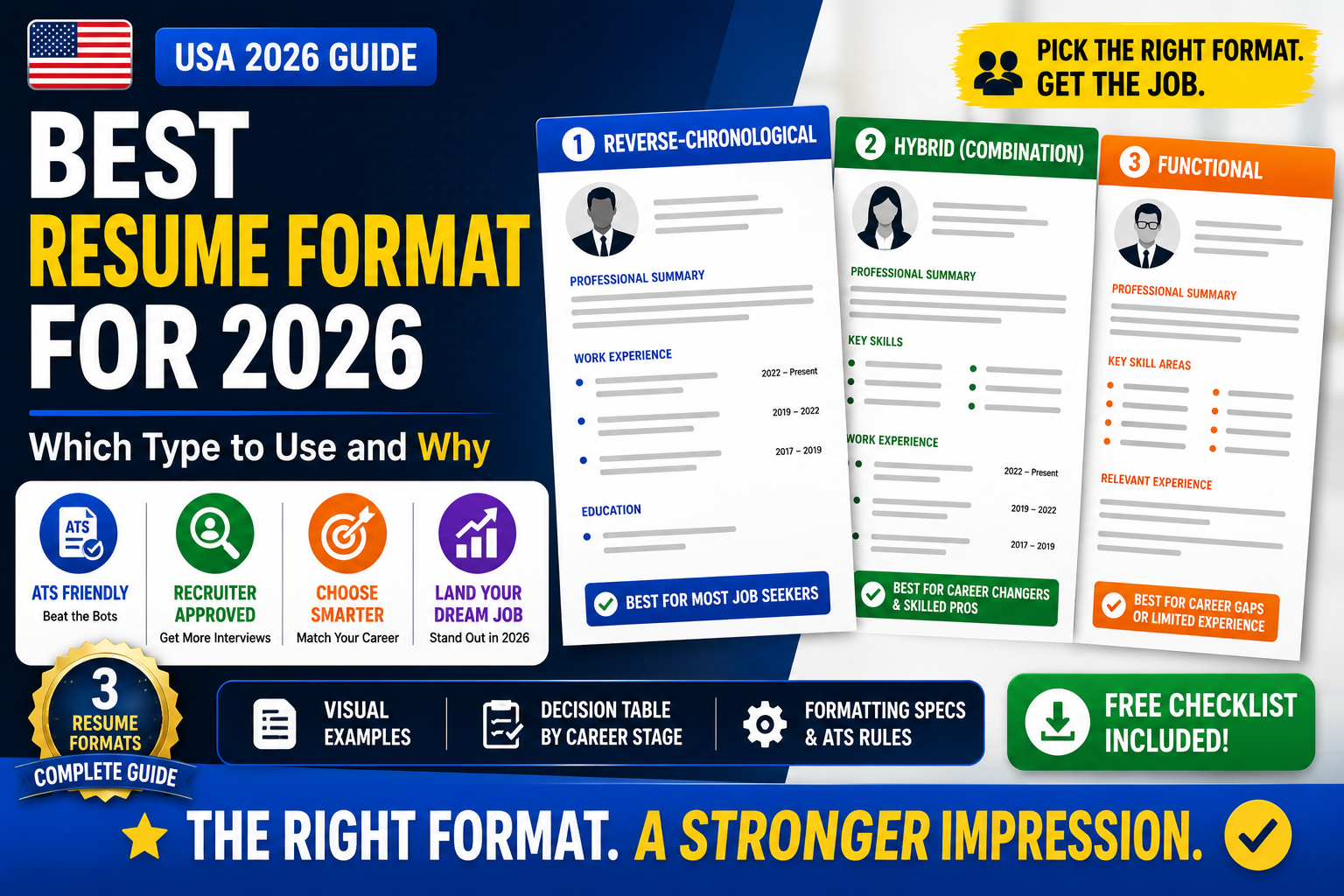
Resume format is one of the most consequential decisions you make before applying for a job yet most candidates treat it as an afterthought. The format you choose determines whether your resume passes ATS screening, whether a recruiter can read it in under 10 seconds, and whether your strongest qualifications appear before they lose interest. This guide covers the three formats US employers see in 2026, breaks down exactly which one fits your situation, and gives you the full layout anatomy and formatting specs to build it correctly.
The 3 Resume Formats at a Glance
Every US resume follows one of three structural formats. They differ in how they organize your experience, skills, and history — and each one sends a different signal to the ATS and the hiring manager reading your profile.
More than 95% of US recruiters and hiring managers expect to see a reverse-chronological format when they open a resume. It’s what every major ATS platform is designed to parse, and it’s the layout that lets a human reviewer scan your most recent experience in under 10 seconds. When in doubt, this format is always the right default choice.
Format 1 — Reverse-Chronological Resume
Reverse-Chronological Resume
A reverse-chronological resume opens with your contact information and a professional summary, then moves directly into your work history — most recent role first, working backward through time. Education, skills, and certifications appear below your work experience. The structure is linear, predictable, and easy to scan.
This format works because it puts your strongest material — your most recent job, your most recent results — at the very top of the page where a recruiter’s eye lands first. It also happens to be the exact structure ATS systems are trained to parse: they extract job titles, company names, dates, and bullet content in chronological order, and this format delivers all of that cleanly without ambiguity.
The one weakness is visibility of employment gaps. If you have a significant gap, it appears immediately in the timeline. For most candidates with a steady career history, this is not an issue — and the format’s advantages far outweigh this minor limitation.
✅ Strengths
- Highest ATS compatibility of all three formats
- Standard format US recruiters know how to read instantly
- Shows career progression at a glance
- Most recent and strongest work appears first
- Works across every industry and experience level
- Simple to customize per application
⚠️ Limitations
- Employment gaps are immediately visible in the timeline
- Career changes can appear jarring without a strong summary
- Doesn’t front-load skills the way a hybrid does
- May look thin for recent graduates with minimal experience
Format 2 — Hybrid (Combination) Resume
Hybrid (Combination) Resume
The hybrid resume takes the chronological structure and adds a prominent skills block before the work experience section. Instead of opening with a single summary paragraph, it leads with a summary plus a “Core Competencies” or “Key Skills” section that lists 8–12 of your strongest qualifications. The work experience section follows in reverse-chronological order, just as it would on a standard chronological resume.
This format is especially valuable for career changers. If your most recent job titles don’t directly match the role you’re targeting, the skills block lets you establish relevance before the recruiter reaches a work history that might raise questions. The skills-first approach says “here’s what I bring” before the reader has a chance to decide “this person’s background doesn’t fit.”
For senior and executive candidates, the hybrid format creates space to communicate scope — P&L responsibility, team size, revenue impact — in the top block before the reviewer has to dig through bullet points to piece it together. It works well for anyone whose most important qualifications are better summarized upfront than scattered across three job entries.
✅ Strengths
- Skills and keywords appear at the top — strong for ATS and human readers
- Best format for career changers and industry transitions
- Ideal for senior professionals with complex, multi-dimensional backgrounds
- Maintains chronological work history that recruiters trust
- More flexible for tailoring to specific roles
- Handles employment gaps better than pure chronological
⚠️ Limitations
- More difficult to structure and write well than standard chronological
- Can become too long without tight editing
- ATS compatibility drops if the skills block is built as a table or two-column grid
- Unnecessary complexity for straightforward same-field applications
Format 3 — Functional Resume
Functional Resume
The functional resume leads with a detailed skills and competencies section rather than a work history timeline. Accomplishments and abilities are grouped under skill categories rather than tied to specific employers. The work history — if it appears at all — is listed at the bottom as a brief, often bullet-free summary of job titles, company names, and dates.
The intention behind this format is to shift attention from where you worked and when, to what you can do. For candidates with long employment gaps, a confusing work history, or skills that span many unrelated jobs, this sounds appealing in theory. In practice, it backfires in the US job market for two reasons.
First, most ATS platforms are designed to extract structured work history. When they encounter a functional format without a clear chronological employment section, they either misparse the content or score the resume as incomplete. Many automated systems simply rank functional resumes lower because key data fields — employer names, job titles, employment dates — are either missing or buried. Second, US recruiters and hiring managers are specifically trained to be skeptical when they see a functional resume. The format is so closely associated with candidates trying to hide something that it raises a flag before you’ve had a chance to make your case.
When It Can Work
- Applying to small businesses that don’t use ATS
- Direct referrals where a recruiter already knows your background
- Returning to workforce after very extended leave
- Portfolio and creative-industry submissions
- No work history at all (student projects, volunteer work)
⚠️ Why It Usually Backfires
- Poor to zero ATS parsing on most major platforms
- US recruiters are trained to be suspicious of this format
- Skills claims without employment context appear unverifiable
- Gaps become more obvious — not less — when history is hidden
- Many ATS portals filter it out or rank it last automatically
If you are applying through any online portal — a company’s careers page, LinkedIn Easy Apply, Indeed, Workday, Greenhouse, iCIMS, Taleo, or any other ATS-powered system — use reverse-chronological or hybrid. The functional format will fail ATS parsing and your resume may never reach a human reviewer, no matter how strong your skills are. Address employment gaps in your summary or cover letter instead of changing your format.
📋 Check If Your Resume Format Passes ATS
Use the USAJobsKit ATS Resume Checker to score your resume’s format, structure, and keywords against any job description — before you hit submit.
Use Free ATS Resume Checker →Which Format Should You Use? (Decision Table)
Use this table to match your specific situation to the right format. If your situation isn’t listed below, default to reverse-chronological — it works for the widest range of candidates and never creates problems in ATS systems.
| Your Situation | Best Format | Why |
|---|---|---|
| Steady career in one field with consistent progression | Reverse-Chronological | Your timeline tells a clear story. ATS reads it perfectly. No reason to change it. |
| Recent graduate with internship or part-time experience | Reverse-Chronological | Lead with education, then internships. Clean, ATS-safe, and expected for new grads. |
| Mid-career professional applying in the same industry | Reverse-Chronological | Your last 10–15 years of experience is your strongest asset. Put it first. |
| Changing careers or pivoting industries | Hybrid | Lead with transferable skills before the reader reaches job titles that may look unrelated. |
| Senior executive or VP-level candidate | Hybrid | Front-load P&L ownership, team size, and key results so scope is visible immediately. |
| Military veteran transitioning to civilian career | Hybrid | Skills block lets you translate military competencies into civilian terms before the reader sees service titles. |
| Employment gap of 12 months or more | Hybrid | A strong summary + skills block gives the recruiter your value before they reach the gap in the timeline. |
| Freelance or contract work history (no single employer) | Hybrid | Group projects under a single “Freelance [Title]” entry. Hybrid’s skills block provides the context. |
| Returning to workforce after extended leave | Hybrid | Lead with skills and current value. Address the leave briefly in the summary — don’t hide it. |
| Recent graduate with no formal work experience | Hybrid | Highlight coursework, tools, and projects in a skills block before a thin employment section. |
| Direct referral to small company with no ATS portal | Functional (only here) | No ATS risk when it goes directly to a human. Skills-first can work if your work history is genuinely hard to represent chronologically. |
Universal Layout Rules for Every Format
These rules apply regardless of which format you choose. Violating any of them reduces ATS compatibility, hurts readability, or signals to a hiring manager that your resume was built from a design template rather than with hiring in mind.
- One column only. Multi-column layouts look polished in design software but ATS parsers read left-to-right and top-to-bottom across the full document width. Two columns cause your job title and a skill from the sidebar to be read as one scrambled string. Use a single column throughout.
- No tables, text boxes, or headers/footers. Tables and text boxes are invisible to most parsers — their content is simply dropped. Headers and footers are skipped by nearly every major ATS, which means any contact information placed in a document header will be extracted as blank.
- Standard section headings only. Use exactly: “Professional Summary,” “Work Experience,” “Education,” “Skills,” and “Certifications.” ATS systems match section headings to predefined field labels. Creative alternatives like “My Story” or “Career Journey” are not recognized and cause misclassification.
- Reverse-chronological order within experience. Even on a hybrid resume, your individual job entries must run most recent to oldest. Every ATS system and human reviewer expects this direction and becomes confused when it’s inverted.
- Consistent date formatting throughout. Pick one format — “Jan 2022 – Mar 2025” or “01/2022 – 03/2025” — and use it on every date entry. Inconsistency causes ATS parsing errors in your employment timeline.
- Standard bullet points only. Use plain dots (•) or hyphens (-). Arrows, custom icons, checkmarks, or emoji-style symbols are either dropped or rendered as unknown characters by older ATS systems.
- Left-align all body text. Centered or justified body text slows down reading and can cause minor parsing issues. Your name can be centered; everything else left-aligns.
- No photos on a US resume. Unlike many European or Asian markets, including a headshot on a US resume is not standard practice and can create unconscious bias or legal concerns for employers. Leave it off entirely.
The Ideal Resume Section Order
Here is the recommended section order for a reverse-chronological or hybrid resume. Required sections must appear on every resume. Hybrid-only sections apply to that format specifically. Optional sections should only be included when they add clear value for the target role.
📄 Resume Layout — Top to Bottom
Research consistently shows that US recruiters spend the first 7–10 seconds scanning the top third of a resume before deciding whether to keep reading. Your target job title, top credential, most relevant employer, and single biggest result should all appear in the top half of page one. A great bullet point buried in your third role down often goes unseen.
Fonts, Margins, Page Length & File Type
These specifications apply to every US resume in 2026 regardless of format. They represent what both ATS systems and human hiring managers respond to best across the widest range of employers and industries.
✍️ Body Font
Arial, Calibri, Garamond, or Georgia — 10 to 12pt
✍️ Name & Headers
Same font family, bold — 14–16pt for name, 12–13pt for section headers
📐 Margins
0.75 to 1 inch on all sides — never below 0.5 inches or above 1.2 inches
📏 Page Length
1 page for under 10 years experience — 2 pages maximum for 10+ years — never 1.5 pages
💾 File Format
.docx as default — text-based PDF if required — never Canva PDF, image PDF, or Google Docs link
📁 File Name
FirstName-LastName-Resume.pdf — no version numbers, no “Final”, no “Updated-v3”
🎨 Color
Black text on white — one accent color for section headers is acceptable, never color-heavy templates
↕️ Line Spacing
1.0 to 1.15 within sections — blank line between sections for visual separation
- Using a Canva or graphic-heavy design template — these fail ATS parsing almost universally
- Placing contact info in the document header — ATS systems skip headers and your phone number disappears
- Using a two-column layout — ATS reads across both columns simultaneously and produces scrambled text
- Submitting as a Google Docs shared link — it is not a file and no ATS system can process it
- Adding a photo — not standard in the US, creates bias concerns, and wastes valuable space
✅ Key Takeaways
- The reverse-chronological format is the right default for most US job seekers — highest ATS compatibility and most familiar to recruiters
- Use the hybrid format if you’re changing careers, re-entering the workforce, have a significant employment gap, or are applying for senior and executive roles
- Avoid the functional format for any application submitted through an online portal — it consistently fails ATS parsing
- Use a single-column layout with no tables, text boxes, graphics, or document headers/footers
- Use standard section headings exactly: Professional Summary, Work Experience, Education, Skills, Certifications
- Keep fonts to Arial, Calibri, Garamond, or Georgia — 10–12pt body, 14–16pt name
- One page for under 10 years experience, two pages maximum for senior professionals — never pad to fill a second page
- Submit as .docx or text-based PDF — never a Canva export, scanned image, or Google Docs link
- Your strongest qualifications should appear in the top third of page one — that’s where recruiter attention is highest
Frequently Asked Questions
Related Resume Tools on USAJobsKit
Related Blog Posts
Related Articles
-
How to Answer Why Should We Hire You? in 2026May 26, 2026