How to Write a Job Specific Cover Letter That Gets You Interviews in 2026
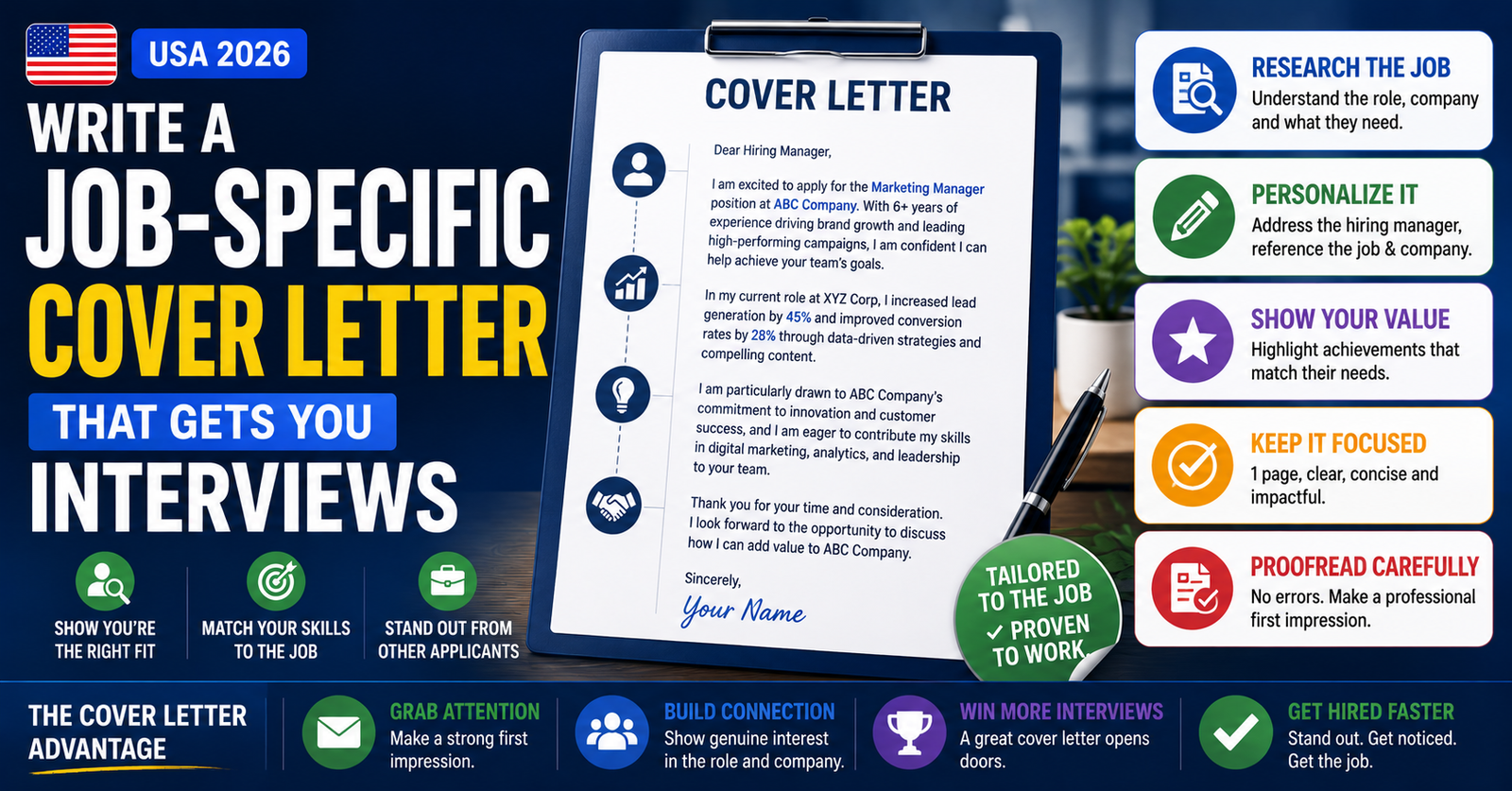
Hiring managers can spot a generic cover letter in under 10 seconds – and they move on just as fast. A job-specific cover letter is one written directly for a single job posting at a single company, using their language, addressing their needs, and connecting your experience to their actual requirements. This guide shows you exactly how to write one, paragraph by paragraph, with real examples for common US jobs.
What Makes a Cover Letter “Job-Specific”?
A job-specific cover letter is written for one job posting at one company. Not a template with a few blanks filled in – but a letter that references the actual role title, addresses the employer’s specific needs, and gives a concrete example or two from your own background that prove you can do the work they’re hiring for.
A generic cover letter says: “I am a motivated professional seeking a challenging opportunity in a dynamic environment.” A job-specific cover letter says: “I saw that Northrop Health is hiring a Patient Care Coordinator in Denver. Over the past three years in that same role at UCHealth, I helped reduce patient scheduling errors by 22% and onboarded 40+ insurance plans into a new EHR system.”
One of those gets read. The other gets deleted.
A generic letter is the same letter sent everywhere. A customized letter changes the company name and job title. A job-specific letter goes deeper – it reflects the job description’s language, addresses the employer’s real problems, and connects your specific experience to their specific needs. That last one is what this guide covers.
Do Cover Letters Still Matter in 2026?
Yes – but not for every application. Here’s the honest picture: many employers skip cover letters entirely for high-volume hourly roles. But for professional, white-collar, and competitive positions, a well-written job-specific cover letter can be the difference between a phone screen and a rejection.
A 2024 survey by ResumeLab found that 83% of US hiring managers say a great cover letter can get an applicant an interview even when their resume isn’t perfect. That alone makes it worth the effort when you’re applying to roles that matter to you.
| Job Type | Cover Letter Value | What Matters Most |
|---|---|---|
| Professional / corporate roles | High – often expected | Specific fit, company research, tone |
| Healthcare / nursing | High – especially for hospital systems | Certifications, patient care experience |
| Teaching / education | High – almost always required | Philosophy, student outcomes, fit with school |
| Tech / engineering | Medium – depends on company | Projects, tools, measurable results |
| Trades (electrician, plumber, etc.) | Low to medium | License, years of experience, reliability |
| Retail / fast food / hourly | Often not read | Availability, past employer history |
The rule of thumb: if you’re applying to a job you really want, write a job-specific cover letter. If you’re mass-applying to hourly positions, a brief standard one is fine.
Before You Write: Research Checklist
A job-specific cover letter requires about 10-15 minutes of research before you write a single word. Skipping this step is why most cover letters read as generic even when the writer thinks they’ve personalized them.
Before writing, find answers to these five questions:
- Who is hiring? – Find the hiring manager’s name on LinkedIn, the company website, or the job posting itself. Address your letter to that person, not “To Whom It May Concern.”
- What are the top 3 requirements? – Read the job description and mark the skills and qualifications mentioned in the first paragraph and the “must-have” section. These are your keywords.
- What does this company actually do? – Spend two minutes on their website. Understand their product or service, their size, and one recent thing they’ve done (new location, award, initiative, product launch).
- What problem are they trying to solve by hiring? – Every job posting is essentially a problem statement. They need someone to grow sales, improve processes, serve patients, manage a team, build software. Identify the core problem and address it directly.
- What one story from your past fits their need? – Pick one specific example from your work history that directly matches what they’re looking for. You’ll use this as the centerpiece of your letter.
Copy the job description into a document and highlight every skill, responsibility, or qualification mentioned. Then open a blank cover letter and make sure at least three of those highlighted phrases appear – naturally – somewhere in your letter. That’s job-specific writing in practice.
Cover Letter Structure: What Goes Where
A US cover letter follows a standard business letter format. Here’s the layout from top to bottom:
- Your contact information – Name, phone, email, LinkedIn URL (optional city/state)
- Date
- Hiring manager’s name, title, company, and address
- Salutation – “Dear [First Name] [Last Name]:” or “Dear Ms. [Last Name]:”
- Opening paragraph – Who you are, what role you’re applying for, and a hook
- Body paragraph 1 – Why you’re qualified: your most relevant experience and one achievement with numbers
- Body paragraph 2 – Why this company: what you know about them and why this specific role fits your direction
- Closing paragraph – Call to action, thank the reader, express interest in an interview
- Sign-off – “Sincerely,” followed by your full name
Keep your cover letter to one page – always. Three to four short paragraphs is the target. Use the same font as your resume (typically 10-12pt Arial, Calibri, or Georgia). Save and submit as a PDF unless the employer specifically asks for a Word file, which preserves your formatting on any device.
Writing Each Paragraph: With Examples
Here’s how to write each section of your cover letter, with before-and-after examples showing the difference between a weak version and a job-specific one.
The Opening Paragraph
Your opening has one job: make the hiring manager want to keep reading. State the role you’re applying for, where you found it, and give one strong hook – a relevant achievement, a personal connection to the company, or a direct statement of fit.
❌ Generic Opening
“I am writing to express my interest in the Marketing Manager position at your company. I believe I would be a great fit for this role and your team.”
✅ Job-Specific Opening
“I’m applying for the Marketing Manager role at Clearwave Health, posted on LinkedIn. In my current position at MedBridge, I built their content marketing function from zero to 12,000 monthly organic visitors over 18 months – the kind of growth I’d love to replicate for Clearwave’s patient acquisition goals.”
Body Paragraph 1 – Your Most Relevant Experience
This is the core of your letter. Pick the one or two things from your background that most directly match the job’s top requirements. Include a specific result with a number. Don’t summarize your whole resume – go deep on one thing that proves you can do this job.
💼 Example – Software Engineer Applying at a Fintech Startup
Job posting says: “3+ years of Python experience, experience with payment APIs, ability to work in a fast-paced startup environment.”
“For the past four years at PayRoute Inc., I’ve worked primarily in Python building backend infrastructure for payment processing systems. My most recent project involved integrating three third-party payment APIs – Stripe, Braintree, and Adyen – into a unified checkout flow that reduced transaction failure rates from 4.2% to 0.9%. I thrive in startup settings where requirements shift fast and shipping speed matters.”
Body Paragraph 2 – Why This Company
This paragraph is where job-specific letters separate themselves from customized ones. Most candidates skip it or write something vague like “I admire your company’s commitment to excellence.” Instead, name something specific you know about the company and tie it to your genuine interest or goals.
❌ Vague Company Interest
“I have always admired your company’s dedication to innovation and look forward to contributing to your team’s continued success.”
✅ Specific Company Connection
“I’ve followed Greenfield Solar’s expansion into community solar programs across the Midwest and saw your recent partnership with Illinois municipalities to bring affordable solar to low-income households. That mission aligns with why I left oil and gas two years ago – and I want to keep doing that work with a company that’s actually moving the needle.”
The Closing Paragraph
Keep this short and direct. Thank the reader for their time, express that you’d welcome a conversation, and include your contact information or a note that it’s in the header. Don’t beg or oversell – a confident, professional close works best.
💼 Strong Closing Example
“Thank you for reviewing my application. I’d welcome the chance to talk about how my background in Python and payment systems can support Clearwave’s engineering roadmap. I can be reached at (312) 555-0194 or at jsmith@email.com anytime.”
✍️ Skip the Blank Page – Build Your Cover Letter in Minutes
Use the USAJobsKit Job-Specific Cover Letter Generator to write a professional, customized cover letter for any role – fast.
Use Free Cover Letter Generator →Full Cover Letter Example
Here’s a complete job-specific cover letter for a Registered Nurse applying to a hospital position in Texas. Read through it and notice how every paragraph connects directly to a specific employer need.
Maria Gonzalez | (512) 555-0172 | m.gonzalez@email.com | Austin, TX
June 1, 2026
Jennifer Park, RN, MSN
Nurse Recruiter, St. David’s Medical Center
Austin, TX 78705
Dear Ms. Park:
OpeningI’m applying for the Registered Nurse position in St. David’s Cardiac ICU, posted on Indeed. After five years in critical care at Ascension Seton Medical Center – including two years specifically in cardiac step-down – I’m looking to move into a dedicated cardiac ICU environment, and St. David’s Heart and Vascular Institute is the strongest program in Central Texas for that next step.
Body – ExperienceIn my current role, I manage a six-patient ICU caseload per shift and serve as charge nurse two to three days per week. Last year I helped lead our unit’s transition to a new EHR platform, training 14 nurses over three weeks with zero disruption to patient care metrics. Our unit’s HCAHPS communication scores improved from the 67th to the 84th percentile over the following quarter – a result I’m proud of and one that came from building trust with patients during high-stress situations.
Body – Company FitI read about St. David’s recent Magnet redesignation and your ICU’s participation in the Texas Cardiac Care Collaborative. That kind of institutional commitment to evidence-based practice is exactly what I’m looking for. I want to grow as a clinician in a setting where protocols are built on outcomes data, not just tradition.
ClosingThank you for considering my application. I’d be glad to speak with you about how my background fits the needs of your cardiac ICU team. Please feel free to reach me at (512) 555-0172 or m.gonzalez@email.com at your convenience.
Sincerely,
Maria Gonzalez, RN, BSN
Adjusting by Industry and Job Type
The core structure stays the same across industries, but tone and emphasis shift depending on what hiring managers in that field actually care about.
Healthcare (Nurses, Medical Assistants, Therapists)
Lead with your license, certifications, and patient care experience. Quantify patient volume, satisfaction scores, or procedural outcomes. Mention the specific unit type (ICU, ER, Pediatrics) in your opening. Hiring managers in healthcare vet clinical experience first, everything else second.
Education (Teachers, Counselors, Administrators)
Reference your teaching philosophy, grade level or subject area, and one student outcome you’re proud of. Mention any knowledge of the school’s curriculum, student demographics, or recent initiatives. School districts in states like Texas and Florida often require cover letters as part of the official application, so format yours as a formal business letter.
Technology (Software Engineers, Analysts, Product Managers)
Keep it lean and technical. Name the specific languages, frameworks, or tools from the job posting. Include one project or result with measurable impact. Tech hiring managers often read cover letters quickly – make the first two sentences count.
Trades (Electricians, Plumbers, HVAC Technicians)
For licensed trade roles, lead with your license type and years of experience. Mention any specialties – commercial, residential, industrial – that match the posting. Keep the letter to two short paragraphs. Most trade cover letters don’t need to be long; a clean, direct one-pager communicates professionalism.
Entry-Level and Recent Graduates
Lean on internships, relevant coursework, projects, and transferable skills. Be honest about where you are in your career, but show confidence in what you bring. One strong internship result beats five vague claims about being a fast learner.
Need a standard cover letter template to start from? Use the Cover Letter Template Generator. Writing a resignation letter instead? Use the Resignation Letter Generator or the Two Weeks Notice Letter Generator.
7 Mistakes That Get Cover Letters Ignored
These are the most common reasons US hiring managers stop reading – and how to avoid each one.
1. Using “To Whom It May Concern”
This opener signals you didn’t try to find the hiring manager’s name. Search LinkedIn for the job title + company name to find the right person. If you genuinely can’t find a name, use “Dear [Department] Hiring Team:” – it’s more specific than a generic salutation and shows effort.
2. Starting With “I Am Applying For…”
Hiring managers read this phrase dozens of times a day. Start with something that immediately shows your value instead. Lead with a relevant achievement, a specific connection to the company, or a direct statement of fit.
3. Repeating Your Resume Word for Word
Your cover letter and resume are two different tools. The resume lists what you’ve done. The cover letter explains why it matters for this specific job. Choose one or two experiences from your resume and go deeper – add context, add numbers, add the outcome.
4. Talking About What the Job Will Do for You
Phrases like “this role will help me develop my skills” and “I’m excited to grow in this field” shift the focus to yourself when it should be on the employer’s needs. Hiring managers want to know what you bring to them – not what they offer you.
5. Going Over One Page
A cover letter is not a narrative essay. One full page is the absolute maximum for any US job application, and most should be shorter – three tight paragraphs beats four sprawling ones. If you’re running long, cut the “why this company” paragraph down to two sentences, and trim any sentence that doesn’t add new information.
6. Sending the Same Letter Everywhere
Hiring managers spot template cover letters immediately. If your letter could have been written for any company in your field, it needs work. The fix is simple: write one strong base letter, then spend five minutes swapping in the company name, the hiring manager’s name, one company-specific detail, and two keywords from the job posting. That alone puts your letter above 80% of the pile.
7. Skipping Proofreading
A typo in a cover letter signals carelessness to a hiring manager before they’ve even met you. Read your letter out loud before sending – your ear catches errors your eye misses. Check especially for the company name and the job title; getting either wrong is an automatic disqualifier at many organizations.
Your cover letter and resume need to tell the same story. Use the Resume Bullet Point Generator to write strong, achievement-focused bullet points that back up the claims in your cover letter. Or use the Resume Accomplishments Generator to pull out results you can feature in both.
✅ Key Takeaways
- A job-specific cover letter references the actual job title, company, and requirements – not just a name swap
- Research the hiring manager’s name, the company’s recent news, and the top 3 job requirements before you write
- Your opening hook should lead with a relevant result or specific connection – not “I am applying for…”
- Body paragraph 1 proves you’re qualified with a specific, numbered achievement
- Body paragraph 2 shows you know the company and explains why this role fits your direction
- One page only – three to four paragraphs is the US standard
- Use keywords from the job description naturally throughout your letter
- Proofread carefully – the company name and job title must be correct