Best Skills to Put on a Resume in 2026 (100+ Examples by Industry)
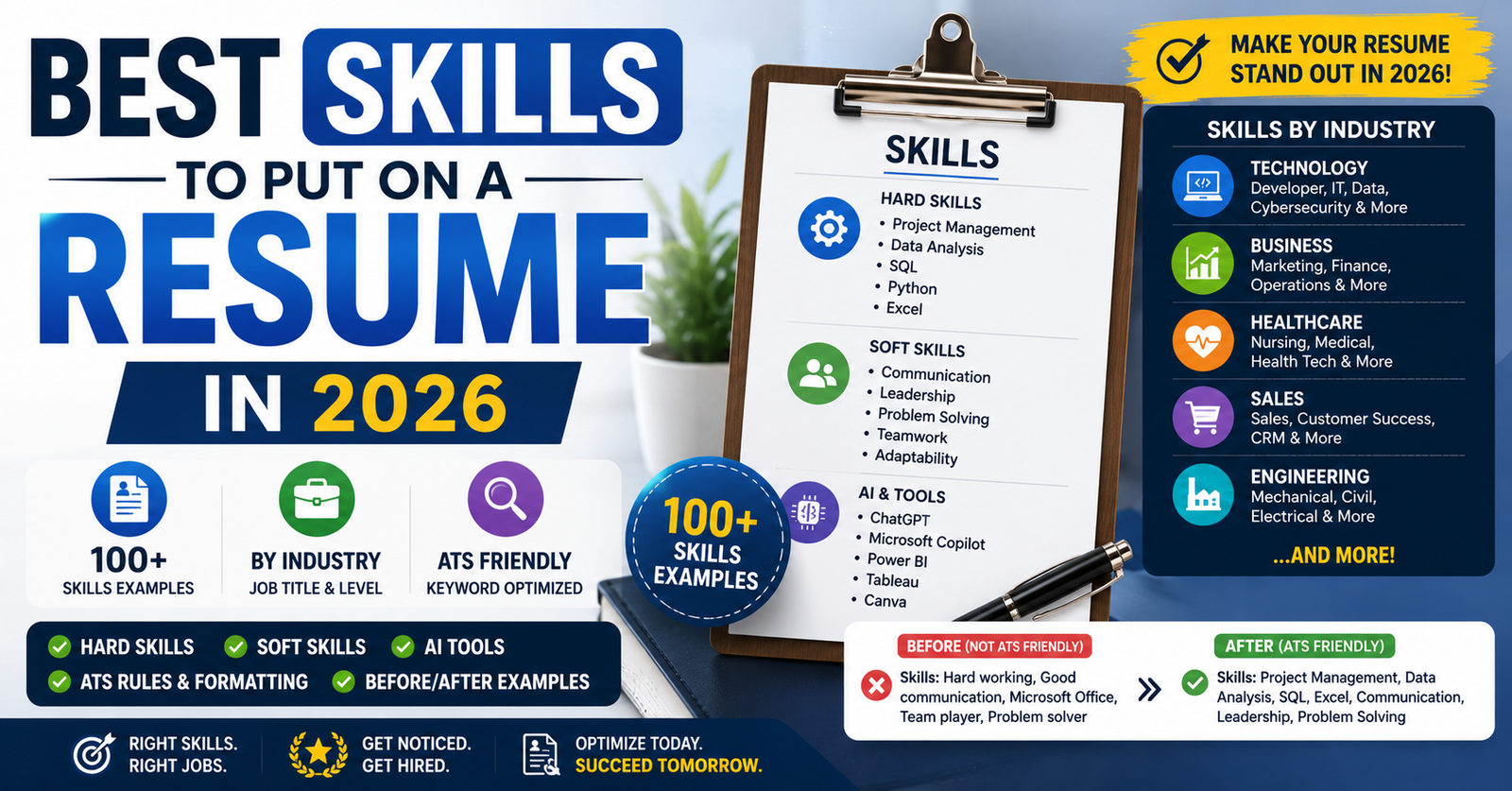
The skills section of your resume has one job: tell an ATS and a hiring manager within seconds that you have what they need. Most candidates either list skills that are too generic to mean anything, skip skills that ATS systems are specifically scanning for, or bury the most relevant ones in a wall of bullet points. This guide gives you 100+ hard skills, soft skills, and AI tools organized by industry, explains exactly how to format your skills section for ATS compatibility, and shows you what a strong skills section looks like versus a weak one.
Hard Skills vs Soft Skills vs AI Skills
Every skill on your resume falls into one of three categories. Understanding the difference helps you build a balanced, credible skills section that satisfies both ATS filters and human reviewers.
🔧 Hard Skills
Specific, teachable, and measurable abilities tied to a tool, technology, process, or domain. These are the skills ATS systems scan for most aggressively. Examples: Python, Salesforce CRM, Google Analytics, SQL, OSHA 30, AWS, Adobe Illustrator.
🤝 Soft Skills
Interpersonal and cognitive abilities that affect how you work with people and solve problems. These matter to hiring managers but must be demonstrated with evidence in your bullet points, not just listed. Examples: Communication, leadership, critical thinking, adaptability.
🤖 AI and Tech Skills
Practical ability to use AI tools, automation platforms, and emerging technologies in your day-to-day work. New for 2026 and increasingly expected across industries. Examples: ChatGPT, Copilot, Midjourney, Make.com, Notion AI, Perplexity.
🌐 Universal Skills
Skills that cross industry boundaries and appear in job postings across virtually every sector. These are safe to include on almost any resume when supported by real context. Examples: Project management, data analysis, stakeholder communication, cross-functional collaboration.
A strong skills section in 2026 includes a balance of all three types. A common mistake is listing only soft skills (which are unverifiable without context) or only technical tools (which look shallow without evidence of how you used them). Aim for 8 to 14 skills total. Lead with your hardest, most relevant technical skills, add 2 to 4 AI or digital tools, and include 2 to 3 soft skills that are directly relevant to the role and supported by examples in your bullet points.
Universal Soft Skills Every Resume Needs
These soft skills appear consistently at the top of US employer surveys and job postings across every industry. The key rule: never list a soft skill without evidence of it somewhere in your work experience section. A soft skill claim without a story to back it up is invisible to hiring managers and means nothing to ATS systems.
Communication
Written, verbal, and presentation skills. Specify the context in your bullets.
Problem Solving
Diagnosing root causes and implementing solutions independently.
Collaboration
Cross-functional teamwork, especially in distributed or hybrid environments.
Adaptability
Adjusting to changing priorities, tools, and structures without loss of output.
Initiative
Identifying and acting on opportunities without being directed to do so.
Critical Thinking
Evaluating information and making sound decisions under uncertainty.
Project Management
Planning, executing, and closing projects on time and within scope.
Time Management
Prioritizing work effectively and delivering results against deadlines.
Growth Mindset
Openness to feedback and a track record of building new skills continuously.
Writing “excellent communication skills” in your skills section without a single bullet in your experience section that demonstrates communication is a wasted line. ATS systems do not weight soft skill claims. Hiring managers dismiss them on sight unless they see them supported. The right approach: list the soft skill in your skills section, then back it up in your work experience with a specific accomplishment that shows it in action.
AI and Technology Skills for 2026
AI literacy has moved from a differentiator to a baseline expectation at most US companies in 2026. Employers across industries now expect candidates to use AI tools practically in their work, not just be aware they exist. Listing AI tools on your resume without context is better than not listing them at all, but the strongest approach is pairing the tool name with a concrete use case in your bullet points. [web:105][web:107]
| AI or Tech Tool | Use Case to List on Your Resume | Most Relevant For |
|---|---|---|
| ChatGPT / Claude | Content drafting, email automation, summarization, research synthesis | Marketing, operations, HR, sales, any professional role |
| Microsoft Copilot | Word, Excel, Outlook, PowerPoint automation and AI-assisted drafting | Office-based roles, project management, finance, admin |
| GitHub Copilot | AI-assisted code completion, documentation generation, debugging support | Software engineers, data scientists, DevOps |
| Midjourney / DALL-E | AI image generation for ads, social media, product mockups, presentations | Designers, marketers, content creators, brand teams |
| Make.com / Zapier | Workflow automation, system integrations, no-code process building | Operations, marketing, sales, RevOps, project management |
| Notion AI | Documentation, knowledge management, automated meeting summaries | Product managers, team leads, operations, HR |
| Grammarly Business | Tone-matched professional writing, AI-assisted editing at scale | Content, communications, customer success, sales |
| Tableau / Power BI | Data visualization, dashboard building, executive reporting | Analysts, finance, operations, marketing, product |
| Salesforce Einstein AI | Predictive lead scoring, opportunity forecasting, AI-driven CRM insights | Sales, CRM administrators, RevOps, customer success |
| Google Gemini | Workspace integration, AI-assisted Docs, Sheets, and Gmail workflows | Any role using Google Workspace |
In your skills section: “AI Tools: ChatGPT, Microsoft Copilot, Make.com, Notion AI”
In your bullet points: “Implemented a ChatGPT-based content workflow that reduced first-draft production time by 60%, enabling the team to publish 3x more articles per month without additional headcount.”
The skill tag alone gets you past ATS. The bullet point is what convinces the hiring manager it’s real.
100+ Skills Organized by Industry
Use this section to build your skills list by finding the industry closest to yours. Skills marked in 🔥 Hot are seeing the highest demand in 2026 job postings. Skills marked in 🤖 AI are AI or automation-related.
Hard Skills
🔥 Python 🔥 Cloud Architecture (AWS/Azure/GCP) JavaScript / TypeScript SQL and NoSQL Databases React / Node.js 🔥 Kubernetes / Docker CI/CD Pipelines REST API Development 🔥 Cybersecurity (Zero Trust) 🤖 GitHub Copilot 🤖 LLM Fine-Tuning Agile / Scrum Systems Design 🔥 Machine LearningSoft Skills
Technical Communication Cross-Functional Collaboration Analytical Thinking Attention to Detail Mentoring Junior Engineers Problem DecompositionHard Skills
🔥 SEO and Technical SEO Google Analytics 4 🔥 Paid Search (Google Ads) Meta Ads Manager Email Marketing (HubSpot, Klaviyo) Marketing Automation CRM (Salesforce, HubSpot CRM) A/B Testing Conversion Rate Optimization 🤖 ChatGPT Content Workflows 🤖 Midjourney / DALL-E 🔥 Product-Led Growth (PLG)Soft Skills
Copywriting Storytelling Brand Voice Development Data-Driven Decision Making Stakeholder PresentationsHard Skills
🔥 Financial Modeling GAAP / IFRS Compliance Variance Analysis QuickBooks / NetSuite / SAP 🔥 FP and A (Financial Planning and Analysis) Excel (Advanced: Power Query, VBA) 🤖 Microsoft Copilot for Finance Accounts Payable and Receivable Budget Management Tax Preparation (CPA) 🔥 Power BI / Tableau Audit and ComplianceSoft Skills
Executive Reporting Attention to Detail Analytical Thinking Confidentiality Cross-Department CommunicationHard Skills
🔥 Electronic Health Records (EHR/EMR) HIPAA Compliance ICD-10 Medical Coding Patient Assessment IV Therapy and Phlebotomy BLS / ACLS Certification 🔥 Telehealth Platforms Medication Administration Epic / Cerner EHR Systems 🤖 AI-Assisted Clinical Documentation Care CoordinationSoft Skills
Patient Advocacy Empathy and Bedside Manner Crisis Management Team Coordination Clear DocumentationHard Skills
🔥 Salesforce CRM Pipeline Management Cold Outreach and Prospecting 🔥 Solution Selling / MEDDIC Contract Negotiation Sales Forecasting Account-Based Marketing (ABM) 🤖 AI Prospecting Tools (Apollo, Outreach AI) Customer Discovery 🔥 SaaS Sales Cycles HubSpot Sales HubSoft Skills
Active Listening Persuasion Relationship Building Resilience Executive PresenceHard Skills
🔥 HRIS (Workday, ADP, BambooHR) Full-Cycle Recruiting Applicant Tracking Systems (ATS) Compensation and Benefits Administration FMLA / ADA / EEOC Compliance 🔥 Employee Engagement and Retention Performance Management Onboarding Program Design 🤖 AI Recruiting Tools (LinkedIn Recruiter, HireVue) L and D Program DevelopmentSoft Skills
Discretion and Confidentiality Conflict Resolution Empathy Policy Communication Workforce PlanningHard Skills
🔥 Project Management (PMP, Agile, Scrum) Process Improvement (Lean, Six Sigma) Jira / Asana / Monday.com KPI Tracking and Reporting Vendor Management 🔥 Supply Chain Management 🤖 Make.com / Zapier Automation Budget Oversight Risk Management ERP Systems (SAP, Oracle) SOP DevelopmentSoft Skills
Stakeholder Management Decision Making Under Pressure Cross-Functional Leadership Resource Planning Executive CommunicationHard Skills
🔥 Figma (UI/UX Design) Adobe Creative Suite (Ps, Ai, Id) User Research and Usability Testing Wireframing and Prototyping Design Systems 🔥 Motion Design (After Effects) 🤖 Midjourney / Adobe Firefly Brand Identity Development Accessibility (WCAG Standards) Video Production (Premiere Pro)Soft Skills
Visual Storytelling Client Communication Receiving Creative Feedback Creative Concept Development Deadline ManagementHard Skills
🔥 Python (Pandas, NumPy, Scikit-learn) 🔥 SQL (Advanced Queries, Window Functions) R Programming Tableau / Power BI / Looker 🔥 Machine Learning and Predictive Modeling A/B Testing and Experimentation Statistical Analysis Snowflake / BigQuery / Redshift 🤖 LLM Integration and Prompt Engineering Data Pipeline Development (dbt, Airflow)Soft Skills
Data Storytelling Business Acumen Translating Insights to Action Stakeholder Communication Intellectual Curiosity🔍 Find the Exact Skills in Your Job Description
Use the USAJobsKit Job Description Keyword Finder to extract the specific hard skills, soft skills, and tools an employer is scanning for so you can match them exactly in your resume.
Use Free Keyword Finder →How to Write Your Skills Section for ATS
The skills section is one of the most frequently misformatted parts of a US resume. Getting the content right matters, but if the format breaks ATS parsing, the content never gets read. These rules apply to every resume submitted through an online portal.
Use a Single-Column Plain Text List
Never put your skills section in a table, text box, or two-column grid. ATS systems read documents linearly. A two-column skills table causes the parser to merge unrelated skills from different columns into scrambled strings. Use a single-column list or a comma-separated paragraph instead.
Use the Exact Keywords From the Job Posting
ATS filters match exact or near-exact keyword strings. If the job description says “Microsoft Excel” and your resume says “spreadsheet software,” that may not match. If it says “Agile methodology” and yours says “agile workflows,” that may not match either. Copy the exact phrasing from the job description and use it in your skills section wherever it applies honestly to your background.
Label Your Skills Section Clearly
Use the heading “Skills” or “Core Skills” — not “My Toolkit,” “What I Bring,” or “Areas of Expertise.” ATS systems map section headings to predefined field labels. Non-standard headings cause the parser to misclassify the content or skip it entirely.
Group Skills by Category for Human Readers
While ATS reads a plain text list, hiring managers benefit from grouped categories. A clean format looks like: Technical: Python, SQL, Tableau | Marketing: Google Ads, HubSpot, GA4 | AI Tools: ChatGPT, Make.com. This format passes ATS and scans quickly for a human reviewer.
Never Use Skill Rating Bars or Stars
Visual skill bars (“Python ●●●●○”) are meaningless to both ATS and hiring managers. ATS cannot parse a graphic element. Hiring managers have no frame of reference for what “4 out of 5 stars” means in practical terms. Use words if proficiency context is needed: “Python (Advanced),” “Spanish (Professional Proficiency),” or “Excel (VBA, Power Query).”
Limit Your Skills Section to 8 to 14 Items
A skills section with 30 entries signals that the candidate listed everything they’ve ever touched rather than curating what’s most relevant. Hiring managers stop reading long lists. Prioritize the skills most directly relevant to the role, add your strongest AI or technical tools, and cut anything generic or unverifiable.
Include Both the Full Name and Acronym for Certifications and Tools
ATS systems may scan for either the full name or the acronym. Writing “Project Management Professional (PMP)” covers both. “Search Engine Optimization (SEO),” “Customer Relationship Management (CRM),” and “Electronic Health Records (EHR)” are all stronger than either version alone.
Bad Skills Section vs Good Skills Section
Here is exactly what a weak skills section looks like compared to a strong one for the same type of candidate — a marketing manager applying for a digital growth role.
❌ Weak Skills Section
Microsoft Office Communication Teamwork Leadership Social Media Detail-Oriented Fast Learner Marketing Customer Service Problem Solving Time Management MultitaskingToo generic. No tools named. No ATS keywords. Soft skill claims without evidence. “Multitasking” is noise. “Microsoft Office” is expected of every candidate and adds no value.
✅ Strong Skills Section
SEO and Technical SEO Google Ads (Search and Display) Google Analytics 4 HubSpot Marketing Hub A/B Testing and CRO Email Marketing (Klaviyo) Salesforce CRM ChatGPT Content Workflows Make.com Automation Data-Driven Decision Making Stakeholder CommunicationNamed tools that ATS can match. Specific platforms that show depth. Two AI tools relevant to the role. Soft skills limited to two that are directly relevant and supported by bullet points.
Skills to Remove From Your Resume Right Now
These skills appear on millions of US resumes and add zero value to any of them. They do not score ATS points because they are either too vague to match job description keywords or so universally assumed that including them signals filler rather than substance. Remove them and replace with specific, verifiable skills.
- “Microsoft Office” — Every candidate has this. If you have advanced Excel skills, write “Excel (Advanced: Pivot Tables, Power Query, VLOOKUP).” That’s a real skill. “Microsoft Office” is not.
- “Multitasking” — This tells a hiring manager nothing verifiable. Replace it with “Concurrent project management” or show it through your bullet points.
- “Hard worker” — Not a skill. Every candidate claims this. It means nothing as a line item and wastes space.
- “Fast learner” — Unverifiable and overused. Show learning speed through a bullet point: “Completed Salesforce Admin certification in 6 weeks while onboarding to a new role.”
- “Good with computers” — You are applying for a professional job in 2026. Basic computer use is assumed. List the specific software and tools you use instead.
- “Detail-oriented” — One of the most overused resume phrases in every industry. Show it through error rates, audit results, or quality metrics in your bullets, not as a standalone skill claim.
- “Team player” — Vague and meaningless without context. Replace with “Cross-functional collaboration” or back it up with a specific team achievement in your work experience.
- “Results-driven” — This should describe every line of your resume, not be its own bullet point. If you have to say you are results-driven rather than showing results, the claim falls flat.
- “Motivated” — Not a skill. A candidate who lists “motivated” as a skill sends a signal that they ran out of real skills to list.
Listing generic skills that every other candidate has tells a hiring manager that your resume is a template, not a tailored application. Every generic skill you remove creates space for a specific, verifiable, ATS-compatible skill that actually differentiates you. Use the Job Description Keyword Finder to find exactly which skills the employer is scanning for and replace your generic placeholders with precise, relevant terms.
✅ Key Takeaways
- A strong resume skills section in 2026 includes a mix of hard skills, soft skills, and AI or automation tools relevant to your role and industry
- AI literacy is now a baseline expectation at most US companies. List the specific AI tools you use with a concrete use case in your bullet points
- Always extract exact keywords from each job description you apply to and match them in your skills section using the same phrasing the employer uses
- Use a single-column plain text format for your skills section. Never use tables, text boxes, two-column grids, or skill rating bars
- Label the section “Skills” or “Core Skills” so ATS systems recognize and parse it correctly
- Limit your skills section to 8 to 14 items. Curate for relevance, not volume
- Include both the full name and acronym for certifications, tools, and systems (for example, “Project Management Professional (PMP)”)
- Every soft skill you list should be backed by at least one specific accomplishment in your work experience section
- Remove generic filler skills: “Microsoft Office,” “multitasking,” “detail-oriented,” “fast learner,” and “team player” add no value to a professional resume