
How Overtime Pay Works in the US – 2026 Guide
Quick Answer
Under the federal Fair Labor Standards Act (FLSA), non-exempt employees must be paid at least 1.5 times their regular rate of pay for every hour worked beyond 40 in a single workweek. Overtime is calculated on a weekly basis – not daily, biweekly, or by pay period. Whether you actually qualify depends on your job duties and salary, not just your job title. The 2026 tax year also introduced a new qualified overtime pay deduction under the One Big Beautiful Bill Act that may reduce the income tax burden on eligible overtime earnings. Use the overtime calculator to see exactly what any extra hours are worth after taxes in your state.
Not sure what overtime does to your paycheck? The paycheck calculator lets you enter overtime hours to see your full gross and estimated net for any week.
Most workers know they are supposed to get “time and a half” for overtime – but the details of who actually qualifies, how the rate is calculated, and what overtime really takes home after taxes are where confusion is common. This guide covers all of it: the federal FLSA rules, the exempt vs. non-exempt distinction, step-by-step overtime calculation with worked examples, the 2026 overtime tax deduction, and state-level rules that go beyond the federal floor.
The federal overtime rule: FLSA basics
The Fair Labor Standards Act (FLSA), enforced by the US Department of Labor’s Wage and Hour Division, is the federal law that governs overtime pay for most private-sector and government workers. Its core rule is straightforward: covered non-exempt employees must receive overtime pay of at least 1.5 times their regular rate of pay for all hours worked beyond 40 in a single workweek.
Several things the FLSA does not require are worth noting explicitly:
- Overtime is not required for working weekends or holidays – only for exceeding 40 hours in the workweek, regardless of which days those hours fall on.
- There is no federal daily overtime rule – hours worked are accumulated weekly, not daily (though some states add daily overtime rules).
- Double time is not federally required – 1.5x is the legal floor; employers can pay more but are not required to.
- There is no federal limit on how many hours employees aged 16 and older may work – only the pay rate for those extra hours is regulated.
- Overtime must be paid in the pay period it was earned – employers cannot defer or average overtime across multiple pay periods.
What counts as a workweek: Under the FLSA, a workweek is any fixed, regularly recurring 168-hour period (seven consecutive 24-hour days). It does not have to align with the calendar week or your pay period. Your employer sets the workweek – it can begin any day at any hour. Hours cannot be averaged across two or more workweeks to reduce overtime liability.
Who qualifies for overtime: exempt vs. non-exempt
Not all employees are entitled to overtime under the FLSA. The law divides workers into two categories: non-exempt (covered by FLSA overtime protections) and exempt (not entitled to overtime regardless of hours worked). The distinction is based on a combination of job duties and salary level – not job title.
| Classification | Overtime entitlement | Typical pay structure | Common examples |
|---|---|---|---|
| Non-exempt | ✅ Must receive 1.5x for hours 40+ | Hourly (and some salaried) | Retail workers, factory workers, warehouse staff, nurses (hourly), admin assistants below salary threshold |
| Exempt – Executive | ❌ No overtime required | Salary ≥ $684/week ($35,568/yr) | Managers who regularly direct 2+ employees and have hiring/firing authority |
| Exempt – Administrative | ❌ No overtime required | Salary ≥ $684/week ($35,568/yr) | Office workers with discretion over significant business matters |
| Exempt – Professional | ❌ No overtime required | Salary ≥ $684/week ($35,568/yr) | Lawyers, doctors, CPAs, engineers, teachers with advanced degrees |
| Exempt – Computer employee | ❌ No overtime required | Salary ≥ $684/week OR $27.63/hr | Systems analysts, programmers, senior software engineers |
| Exempt – Outside sales | ❌ No overtime required | No minimum salary required | Sales employees who work primarily outside the employer’s premises |
Important: Exempt status is determined by actual job duties – not by what your employer calls your role. A worker labeled “manager” who does not regularly supervise two or more employees and does not have genuine hiring or firing authority is not exempt on that basis alone. Misclassification as exempt to avoid paying overtime is an FLSA violation. If you believe you have been misclassified, the Department of Labor’s Wage and Hour Division handles complaints.
How to calculate overtime pay: step by step
The basic overtime calculation has three inputs: your regular hourly rate, your overtime hourly rate (1.5x), and the number of overtime hours worked. For hourly employees, the math is straightforward. For salaried non-exempt employees, the calculation requires one additional step to establish the regular hourly rate first.
Example 1: Hourly worker
Setup: Regular rate = $18/hr. Hours worked in the week = 47.
- Regular hours: 40 × $18.00 = $720.00
- Overtime rate: $18.00 × 1.5 = $27.00/hr
- Overtime hours: 47 – 40 = 7 hours
- Overtime pay: 7 × $27.00 = $189.00
- Total gross for the week: $720.00 + $189.00 = $909.00
Example 2: Salaried non-exempt worker
Setup: Weekly salary = $800 for a 40-hour week. Hours worked this week = 48.
- Regular hourly rate: $800 ÷ 40 = $20.00/hr
- Overtime rate: $20.00 × 1.5 = $30.00/hr
- Overtime hours: 48 – 40 = 8 hours
- Overtime pay: 8 × $30.00 = $240.00
- Total gross for the week: $800.00 + $240.00 = $1,040.00
Use the overtime calculator to run any combination of regular rate and overtime hours without doing the math manually.
Example 3: Worker with a non-discretionary bonus
The FLSA requires that most non-discretionary bonuses (production bonuses, attendance bonuses, shift differentials) be included in the regular rate of pay when calculating overtime – not just the base hourly rate. This increases the regular rate and thus the overtime rate.
Setup: $18/hr base rate. $80 production bonus earned during a 48-hour week.
- Total straight-time compensation: (48 × $18) + $80 = $864 + $80 = $944
- Regular rate of pay: $944 ÷ 48 hours = $19.67/hr
- Overtime premium: $19.67 × 0.5 = $9.84/hr (the additional half-time owed on overtime hours)
- Overtime premium total: 8 hours × $9.84 = $78.72
- Total gross for the week: $944.00 + $78.72 = $1,022.72
Note: Truly discretionary bonuses (those not promised in advance and given at the employer’s sole discretion) are excluded from the regular rate calculation.
Overtime and taxes in 2026
Overtime pay is taxed as ordinary income – the same rates that apply to your regular wages. There is no special “overtime tax” bracket. However, the mechanics of payroll withholding mean that a paycheck with significant overtime hours typically has more federal income tax withheld than a regular paycheck of the same gross amount, because employers apply the marginal rate to the full check rather than separating overtime hours for different withholding treatment.
This does not mean you pay more tax overall on overtime – it means more may be withheld from that specific paycheck, and that extra withholding is reconciled when you file your annual return. Your total federal income tax liability for the year is based on your total annual income, not on any individual paycheck’s breakdown.
2026 qualified overtime deduction: The One Big Beautiful Bill Act introduced a qualified overtime pay deduction for 2026. Eligible non-exempt employees may be able to deduct qualifying overtime wages from their taxable income up to a specified cap on their annual return. This deduction effectively reduces the income tax burden on overtime earnings for covered workers. The deduction is claimed at year-end on your Form 1040 – your paycheck withholding on overtime hours does not automatically reflect it. Work through the expanded Step 4(b) Deductions Worksheet on your 2026 W-4 form if you expect substantial overtime earnings, as adjusting your withholding to reflect the deduction can increase your per-paycheck take-home throughout the year rather than waiting for a refund when you file.
To model what a specific overtime paycheck actually takes home after federal withholding and state tax, the paycheck calculator lets you enter both your regular hours and overtime hours for any pay period and see the estimated net by state.
State overtime rules that go beyond the FLSA
The FLSA sets a federal floor – states can and do go further. Some states have higher overtime pay requirements or daily overtime rules that apply on top of the weekly federal rule. Where a state law is more favorable to the employee than the FLSA, the state rule governs.
| State | Daily overtime rule | Additional notes |
|---|---|---|
| California | 1.5x after 8 hrs/day; 2x after 12 hrs/day | Also 1.5x for first 8 hrs on 7th consecutive workday; 2x after 8 hrs on 7th day |
| Alaska | 1.5x after 8 hrs/day | Also applies weekly threshold of 40 hours |
| Nevada | 1.5x after 8 hrs/day (if earning below 1.5x minimum wage) | Daily rule applies only to employees below a wage threshold |
| Colorado | 1.5x after 12 hrs/day or 12 consecutive hours regardless of start/end time | Also covers employees in the Colorado COMPS Order industries |
| All other states | No daily overtime requirement | FLSA weekly 40-hour rule applies; some states have higher minimum wages that affect the overtime rate base |
For California workers specifically, overtime calculations are more complex due to daily overtime, the seventh consecutive day rule, and how non-discretionary compensation is blended into the regular rate. The California paycheck calculator accounts for state-specific overtime rules when estimating your take-home.
Compensatory time off (comp time) in place of overtime pay
Some employees receive paid time off in lieu of overtime pay – commonly called “comp time.” Under the FLSA, private-sector employers cannot substitute comp time for overtime pay. Non-exempt employees at private companies must be paid cash overtime at 1.5x – they cannot be offered comp time instead, even if the employee agrees to it.
The exception is state and local government employers, which the FLSA permits to offer comp time to employees under specific conditions, provided the comp time is accrued at a rate of at least 1.5 hours for each overtime hour worked (matching the 1.5x cash rate equivalent). Public safety employees can accumulate up to 480 hours of comp time; other employees can accumulate up to 240 hours.
Know your rights: If your private employer is offering comp time instead of overtime pay and telling you this is standard or legal, that is an FLSA violation. You are entitled to monetary overtime pay – not just future time off – for overtime hours worked. Complaints can be filed with the Department of Labor’s Wage and Hour Division.
Overtime for salaried employees: common misconceptions
A widespread misconception is that salaried employees are automatically exempt from overtime. That is incorrect. Salaried status alone does not determine overtime eligibility – it is one of two tests, and both must be met for the white-collar exemptions to apply:
- Salary level test: The employee must earn at least $684 per week ($35,568 per year) on a salary basis.
- Duties test: The employee’s primary job duties must genuinely fall within the executive, administrative, professional, computer, or outside sales categories as defined by the FLSA.
An employee who meets the salary level test but whose actual duties do not qualify under the duties test remains non-exempt and entitled to overtime. A salaried worker earning $40,000 per year whose job does not involve managing employees, exercising independent judgment over significant matters, or requiring advanced professional knowledge is not exempt simply because they receive a fixed weekly salary.
The practical implication: if you are a salaried employee who consistently works more than 40 hours per week and your role does not clearly match the duty requirements of a white-collar exemption, it is worth understanding whether you are correctly classified. The how much should you earn guide can help you benchmark your total compensation against your actual role in the market.
How much is overtime really worth after taxes?
The gross value of overtime hours is straightforward – it is 1.5 times your regular rate. The net value after taxes is the more useful number for budgeting and financial planning. Because overtime earnings are added to your regular wages in the same paycheck, the effective withholding rate on an overtime-heavy week can feel higher than normal – more of the check falls into your upper marginal bracket.
Scenario: $20/hr worker, 10 hours of overtime in one week, Texas resident
- Regular wages: 40 × $20 = $800
- Overtime wages: 10 × $30 = $300
- Gross for the week: $1,100
- Annualized for withholding purposes (biweekly pay): ~$28,600/yr equivalent rate
- Estimated federal withholding on this check (single filer, standard): ~$110–$130
- FICA (Social Security + Medicare): ~$84
- State income tax: $0 (Texas)
- Estimated net for the week: ~$880–$906
Use the overtime calculator and paycheck calculator together to see the after-tax value of any overtime scenario for your specific state and filing status.
USAJobsKit paycheck and overtime tools
Overtime Calculator
Enter your regular rate and overtime hours to calculate gross overtime pay instantly.
Open the overtime calculatorPaycheck Calculator
Include overtime hours alongside regular hours to see your full estimated after-tax paycheck.
Open the paycheck calculatorHourly to Salary Calculator
Convert any hourly rate – regular or overtime – into an annual salary equivalent.
Open the hourly to salary calculatorTake-Home Pay Calculator
See what any annual or weekly gross income – including overtime – nets in your state after all taxes.
Open the take-home pay calculatorGross to Net Calculator
Get the after-tax take-home from any gross weekly or annual amount, including overtime-heavy pay.
Open the gross to net calculatorBonus Tax Calculator
See how supplemental wages like bonuses and shift differentials are withheld alongside regular pay.
Open the bonus tax calculatorRelated reading on USAJobsKit
- How to calculate take-home pay – understand the full after-tax picture including overtime weeks
- How to fill out a W-4 in 2026 – adjust withholding to reflect the 2026 qualified overtime deduction
- How bonuses and commissions affect pay – how non-discretionary bonuses factor into the regular rate for overtime
- W-2 vs 1099 – 1099 independent contractors are not covered by FLSA overtime rules
- What is a good salary in the US in 2026? – put your regular and overtime earnings in national context
- Top paying trade jobs in the US – overtime is a significant income booster in trades where 40+ hour weeks are common
- Best entry-level jobs that pay well – many hourly entry-level roles build real income through consistent overtime
FAQ
How does overtime pay work in the US?
Under the FLSA, most non-exempt employees must receive at least 1.5 times their regular hourly rate for all hours worked beyond 40 in a single workweek. Overtime is calculated on a per-workweek basis – not daily (except in states like California), not biweekly, and not monthly. It must be paid in the pay period in which it was earned. Hours cannot be averaged across multiple weeks to avoid overtime liability. Exempt employees – those who meet both the salary level and duties tests for white-collar exemptions – are not entitled to FLSA overtime.
How do I calculate overtime pay?
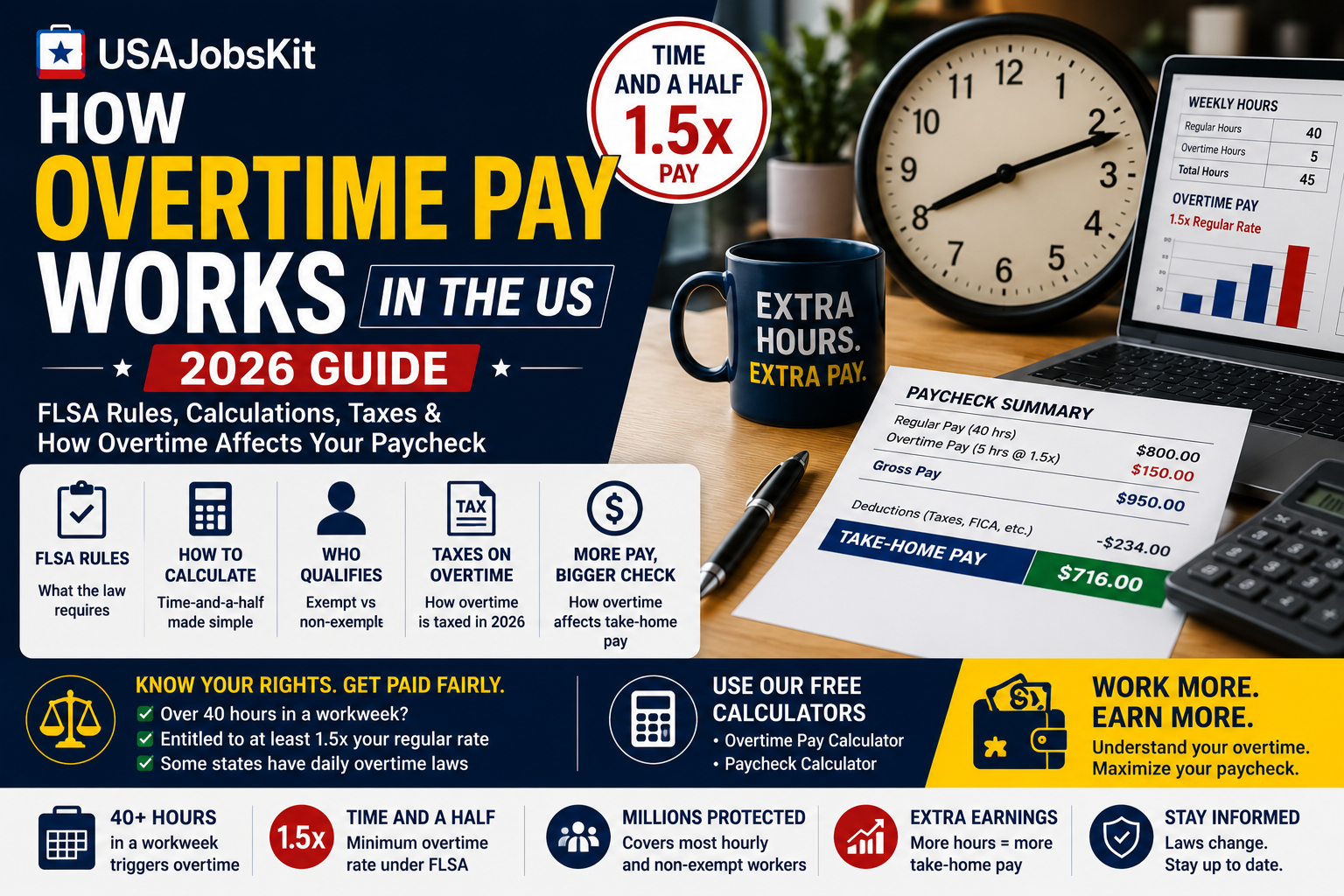
Multiply your regular hourly rate by 1.5 to get your overtime rate. Then multiply the overtime rate by the number of hours over 40 you worked that week. Add the result to your regular weekly pay. Example: $20/hr regular rate → $30/hr overtime rate. 45 hours worked → 5 overtime hours → $30 × 5 = $150 overtime pay + $20 × 40 = $800 regular pay = $950 gross for the week. Use the overtime calculator for any variation including non-discretionary bonus adjustments.
Who is exempt from overtime pay?
Employees who meet the FLSA’s salary level test (earning at least $684/week on a salary basis) AND the duties test for executive, administrative, professional, computer, or outside sales exemptions are not entitled to federal overtime. Job title alone does not determine exempt status – actual duties control. Many workers labeled as managers or administrators are non-exempt under the FLSA’s actual duties test. Misclassification complaints can be filed with the DOL Wage and Hour Division.
Does overtime get taxed more?
Overtime pay is not taxed at a higher rate – it is taxed as ordinary income at the same marginal rates as your regular wages. However, a paycheck with large overtime earnings may have more total federal income tax withheld because the full check size pushes into a higher marginal bracket for withholding purposes. This extra withholding is reconciled at year-end through your tax return. The 2026 qualified overtime deduction under the One Big Beautiful Bill Act may further reduce the effective tax burden on qualifying overtime earnings.
Is overtime pay taxed differently in 2026?
The One Big Beautiful Bill Act introduced a qualified overtime pay deduction for 2026 that allows eligible non-exempt employees to deduct qualifying overtime wages from taxable income up to a specified cap on their annual return. This deduction does not change how your employer withholds on overtime paychecks – it is claimed at year-end on Form 1040. Workers expecting significant overtime should work through the expanded Deductions Worksheet on their 2026 W-4 to adjust withholding and reflect the deduction throughout the year. Consult a tax professional for your specific situation.
Does my employer have to pay overtime for more than 8 hours a day?
Under federal FLSA rules, no – daily overtime is not required. Overtime is triggered only by exceeding 40 hours in the workweek. However, California requires 1.5x pay for hours over 8 per day and 2x pay for hours over 12 per day. Alaska and Nevada also have daily overtime provisions. Colorado requires 1.5x after 12 hours in a workday or 12 consecutive hours. If you work in one of these states, both the daily and weekly rules apply, and whichever produces the greater overtime entitlement governs.
Sources
- US Department of Labor – Overtime Pay (FLSA)
- US Department of Labor – Overtime Pay Rules and Requirements
- US Office of Personnel Management – How to Compute FLSA Overtime Pay
- USAGov – Overtime Pay
- Workforce.com – Overtime Laws by State (2026 Update)
Final takeaway
Overtime pay in the US is governed by a clear federal rule – 1.5x for hours beyond 40 in a workweek – but the details that matter most are whether you are correctly classified as non-exempt, whether your employer is including non-discretionary bonuses in your regular rate, and what your overtime actually takes home after taxes in your specific state.
Use the overtime calculator to see the gross value of any overtime scenario, and the paycheck calculator to add state tax and see the real net amount before you count on that income for your budget.
Calculate your overtime pay and take-home in seconds
Enter your regular rate, hours worked, and state to see both gross overtime and estimated after-tax net.
Disclaimer: This article is for general educational and informational purposes only. It does not constitute legal, tax, or employment advice. FLSA rules are complex and subject to regulatory updates. State overtime laws vary significantly. If you believe you have an overtime pay dispute or have been misclassified, consult an employment attorney or contact the Department of Labor’s Wage and Hour Division. Tax treatment of the 2026 qualified overtime deduction should be confirmed with a qualified tax professional.