Beginner’s Guide to US Payroll Taxes (2026)
Quick Answer
Payroll taxes are the taxes that are taken from your paycheck and paid by your employer on your behalf. They include federal income tax, state income tax, and FICA taxes for Social Security and Medicare. These taxes, plus any benefits and other deductions, turn your gross pay into your net pay or take home pay. If you want to see how payroll taxes affect your own paycheck, you can use tools such as the Payroll Tax Calculator, Income Tax Calculator, and Take Home Pay Calculator.
Payroll taxes can feel confusing because they involve several different tax types, multiple government agencies, and a lot of jargon. The good news is that as an employee you do not have to calculate them yourself, but understanding how they work will help you read your pay stub, plan your budget, and avoid surprises at tax time.
This beginner friendly guide explains US payroll taxes in plain English. You will see what each major tax type is, who pays it, how it shows up on your paycheck stub, and how to use USAJobsKit tools to estimate your own numbers.
1. What are payroll taxes?
When you receive a paycheck from an employer in the United States, you rarely get the full amount you earned. Your employer withholds money for taxes and certain benefits and sends those taxes to the government.
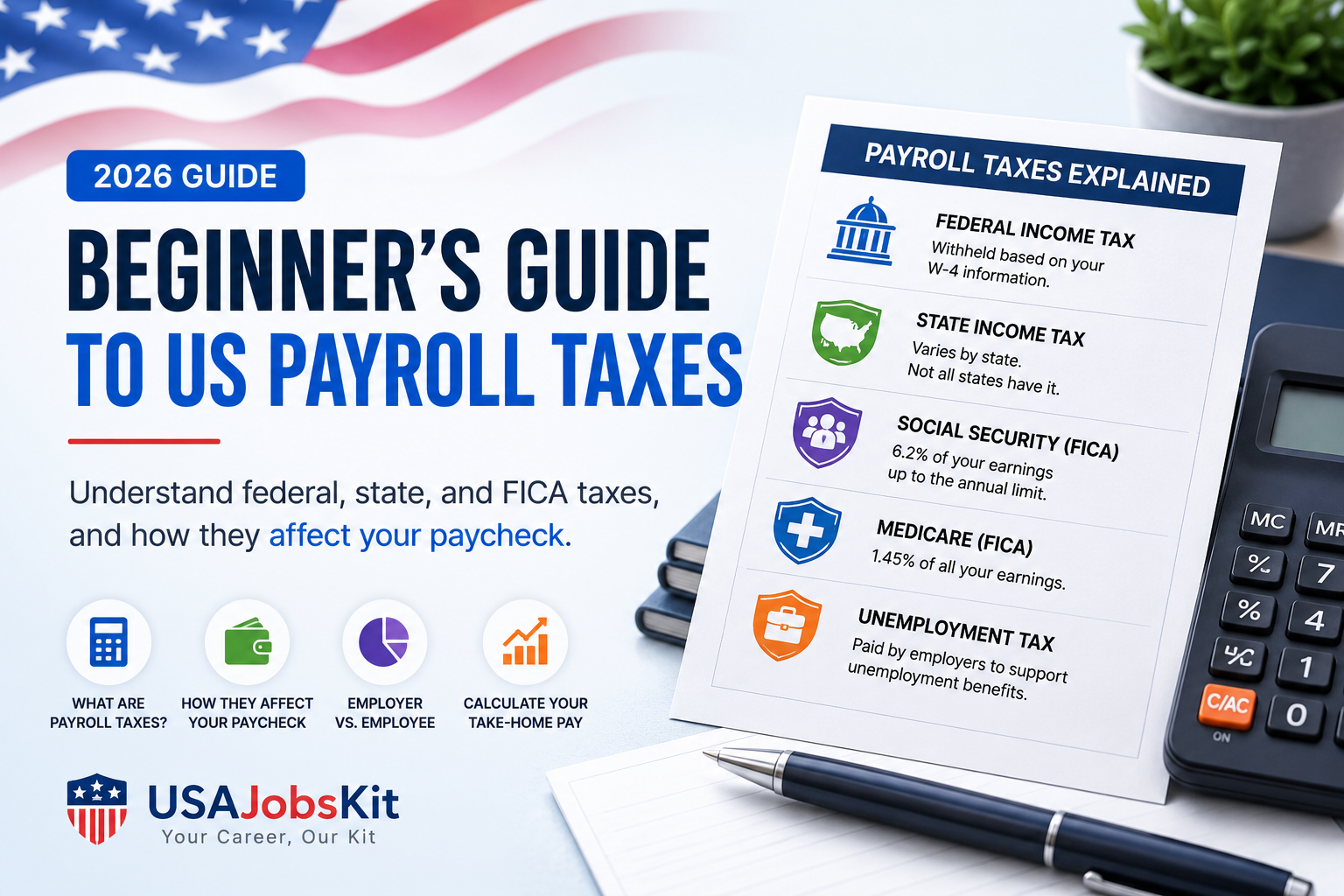
The main payroll tax categories are:
- Federal income tax withheld for the IRS.
- State and local income tax in states and cities that have them.
- Social Security tax and Medicare tax, often grouped as FICA.
- Unemployment taxes, which are usually paid by employers and do not show up as deductions from your pay.
Your employer is responsible for calculating payroll taxes, withholding the correct amounts from your wages, and sending them to the tax authorities on a regular schedule. These payments are tied to the information you provide on forms such as Form W 4.
If you have never looked closely at your pay stub before, you may find this guide easier to follow if you open it alongside our article on How to Read Your Paycheck Stub.
2. Federal income tax
Federal income tax is the amount of money the federal government collects from your wages based on your total income and your tax filing status. This is usually the largest single tax line on an employee paycheck.
How federal income tax is calculated on your paycheck
Your employer estimates your federal tax using:
- The gross pay you earned in this period.
- The information you entered on Form W 4, such as your filing status and any extra withholding.
- IRS withholding tables, which are updated regularly.
On your paycheck stub, this line is often labeled “FED”, “Federal Tax”, or “Fed Withholding”. It reduces your net pay now so you hopefully do not owe a large amount when you file your annual tax return.
To experiment with different income levels or see how much federal tax might be taken out at your salary, you can use the Income Tax Calculator and the Federal Tax Calculator. If you want to test different W 4 choices, the Tax Withholding Calculator can help you see how your paycheck might change.
3. State and local income taxes
In addition to federal income tax, many states and some cities or local areas also charge income tax. These are separate from federal tax and are handled according to each state’s rules.
You may see the following on your pay stub:
- State income tax (ST or State Withholding).
- City tax or local income tax in certain cities.
- School district or other local items in some locations.
Not all states have an income tax. States like Texas, Florida, Nevada, and Washington do not tax wage income at the state level, so you will not see a state income tax line if you live and work there. However, other taxes like property or sales tax might be higher to offset this.
Your state and local taxes affect how much of your federal taxable income you actually keep. To understand the impact in your own situation, you can use your state specific paycheck calculator, such as:
- California Paycheck Calculator
- New York Paycheck Calculator
- Texas Paycheck Calculator
- Florida Paycheck Calculator
You can see all available state tools in the Paycheck Calculators section.
4. FICA taxes: Social Security and Medicare
FICA stands for Federal Insurance Contributions Act. These taxes fund Social Security and Medicare programs. They are based on a percentage of your wages and are shared between you and your employer.
Social Security tax
Social Security tax is normally 6.2 percent of your wages up to a yearly limit called the wage base. Your employer also pays a matching 6.2 percent on top of what you see on your pay stub.
On your paycheck stub you might see this line labeled “SS”, “Soc Sec”, or “OASDI”. It is usually listed near “MED” or “Medicare”.
Medicare tax
Medicare tax is normally 1.45 percent of your wages, with an additional small percentage for very high earners above a certain threshold. Your employer also pays a matching 1.45 percent.
On your pay stub this line is often labeled “MED”, “Medicare”, or grouped under “FICA”.
Together, Social Security and Medicare taxes are sometimes summarized as “FICA” on the pay stub. You can explore these more deeply with the FICA Tax Calculator and Medicare Tax Calculator.
5. Unemployment taxes (usually employer only)
Payroll taxes also include unemployment taxes, but these are usually paid by employers and do not appear as deductions from your own pay. Instead, they are part of your employer’s cost of having employees.
The main categories are:
- FUTA (Federal Unemployment Tax Act) at the federal level.
- SUTA or state unemployment taxes at the state level.
These taxes help fund unemployment benefits for workers who lose their jobs. You may see them mentioned in employer documents or HR materials, but they usually do not show up as a line item on your pay stub.
6. Payroll taxes and your paycheck stub
From your point of view as an employee, payroll taxes are most visible on your paycheck stub. They appear in the deductions section and reduce your gross pay to your net pay.
A typical paycheck stub includes:
- An earnings section that shows your regular pay, overtime, bonuses, and other income.
- A taxes section that lists federal, state, local, Social Security, and Medicare taxes withheld.
- A pre tax deductions section for benefits that reduce taxable income such as 401(k) and health insurance.
- A post tax deductions section for other items such as Roth contributions or union dues.
- A net pay line that shows what arrives in your bank account.
If you want a detailed walkthrough of every line on a typical stub, open our dedicated article on How to Read Your Paycheck Stub. It pairs nicely with this guide and shows how the taxes we are describing here appear in real life.
7. How payroll taxes turn gross pay into net pay
You can think of your paycheck as a simple formula:
Gross pay minus payroll taxes minus other deductions equals net pay
In more detail:
- Start with gross pay (for example, hourly rate times hours, or salary share for this period).
- Subtract pre tax deductions such as 401(k) and some insurance premiums.
- Apply federal, state, and local income taxes to the remaining amount.
- Apply FICA Social Security and Medicare taxes on eligible wages.
- Subtract any post tax deductions.
- The result is your net pay or take home pay.
This is exactly the workflow that your payroll department or payroll software follows behind the scenes. If you want to run the same steps for your own situation, you can use:
- Payroll Calculator to see the full distribution.
- Payroll Tax Calculator to focus just on the tax portions.
- Take Home Pay Calculator to jump straight to your net pay.
8. How Form W 4 affects payroll taxes
When you start a job or want to adjust your withholding at an existing job, you complete Form W 4. This form does not change the tax rates themselves, but it tells your employer how much federal income tax to withhold from each paycheck.
On W 4 you will specify things like:
- Whether you are single, married, or head of household.
- Whether you have more than one job or a working spouse.
- Whether you want extra money withheld each paycheck.
If too little is withheld over the year, you may owe money at tax time. If too much is withheld, you are likely to receive a refund, but you have essentially given the government an interest free loan. Tools like the Tax Withholding Calculator and Net to Gross Calculator can help you see how different choices may affect your paycheck.
9. Payroll taxes for hourly versus salaried workers
Payroll taxes apply to both hourly and salaried workers, but the way your gross pay is calculated is different.
- Hourly workers: gross pay is based on your hourly rate multiplied by hours worked, plus any overtime or additional pay.
- Salaried workers: gross pay is your annual salary divided by the number of pay periods in the year.
After gross pay is calculated, the same tax rules (federal, state, FICA, and so on) apply. You can convert between hourly and salary using the Hourly to Salary Calculator and Salary to Hourly Calculator, then plug the result into the Take Home Pay Calculator to see the effect on net pay.
10. How to estimate your own payroll taxes
You do not need to become a payroll expert to get a good estimate of your own payroll taxes. A few simple inputs and the right tools can get you very close.
Here is a common approach:
- Use the Salary Calculator or Hourly to Salary Calculator to confirm your annual gross pay.
- Choose the appropriate state tool in the Paycheck Calculators section.
- Enter your filing status, pay frequency, and pre tax deduction choices.
- Review the breakdown of federal, state, and FICA taxes plus any other deductions.
If you only want to focus on taxes for planning purposes, you can skip directly to the Payroll Tax Calculator, Income Tax Calculator, and FICA Tax Calculator.
FAQ
What are payroll taxes in the United States?
Payroll taxes are taxes that are withheld from wages and salaries and paid to the government by employers. They include federal and state income taxes, Social Security tax, Medicare tax, and in many cases local and unemployment related taxes.
Who pays payroll taxes, the employer or the employee?
Both. Employees pay federal, state, and local income taxes based on what is withheld from their pay. They also pay the employee share of Social Security and Medicare taxes. Employers pay their own share of Social Security and Medicare and usually pay unemployment taxes as well.
How do payroll taxes affect my paycheck?
Payroll taxes are one of the main reasons your net pay is lower than your gross pay. The more tax that is withheld, the smaller your paycheck is today, but the less likely you are to owe additional tax when you file your return. Tools like the Take Home Pay Calculator and Paycheck Calculator can show you the impact in dollars.
Can I change how much payroll tax is withheld from my pay?
You can change the federal and sometimes state income tax portion of your payroll taxes by submitting a new Form W 4 to your employer. This lets you adjust withholding to better match your expected annual tax. However, Social Security and Medicare tax rates are set by law and cannot be changed.
How can I estimate my payroll taxes?
You can estimate your payroll taxes by combining your expected gross pay with your filing status and location in one of USAJobsKit’s tools. Start with the Payroll Tax Calculator if you want a tax focused view or the Take Home Pay Calculator if you want to see net pay directly.
See how payroll taxes change your own paycheck
Use your actual hourly rate or salary, state, and benefits to see a complete breakdown of taxes and take home pay.
Disclaimer: This article is for general educational purposes only and does not provide tax, legal, or financial advice. Payroll tax rules change over time and can differ by state and local area. For personal advice about your situation, please consult a qualified tax professional or financial advisor.