
Truck Driver Salary in the US in 2026
Quick Answer
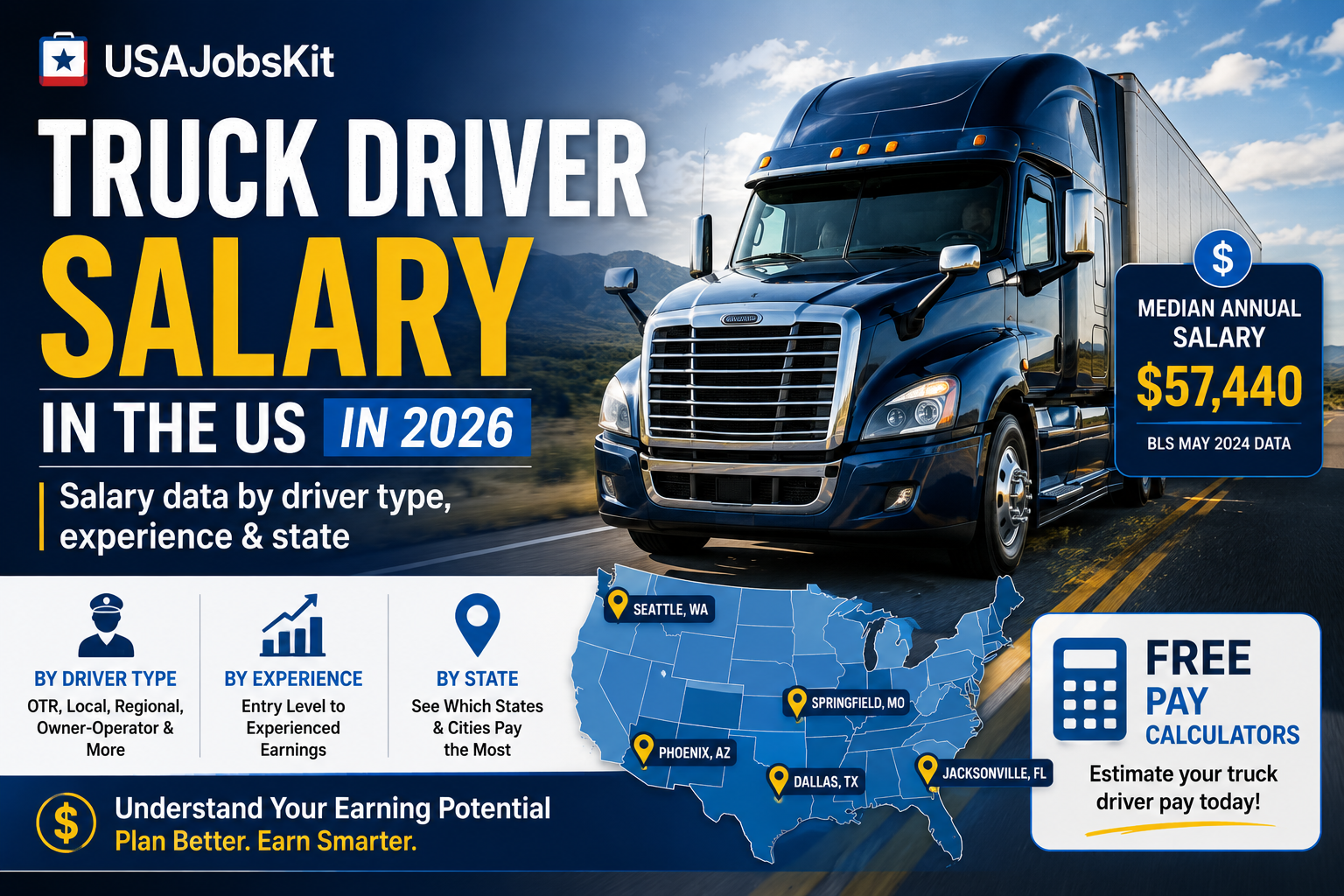
Most US truck drivers earn between $50,000 and $70,000 per year in 2026, depending on driver type, route, experience, and state. The Bureau of Labor Statistics reported a median annual wage of $57,440 for heavy and tractor-trailer truck drivers as of May 2024, and current job market data places the typical range close to that figure. Specialized drivers – hazmat, tanker, and oversized load – consistently earn more. To estimate your hourly rate, weekly pay, or take-home from any truck driving salary, use the truck driver salary calculator or the hourly to salary calculator.
Truck driving is one of the few skilled careers in the US that pays a solid middle-class wage without requiring a four-year degree. But the salary range is wide – a local delivery driver and an over-the-road hazmat driver can both hold a CDL and earn very different annual incomes. Where you drive, what you haul, how you are paid, and how many miles you put in all matter.
This guide covers real 2026 salary data across driver types and experience levels, explains how truck driver pay is structured, and identifies what moves the number up or down for a working driver.
Truck driver salary overview in 2026
Multiple data sources point to a consistent range for truck driver compensation in the US. The Bureau of Labor Statistics (BLS) reported a median annual wage of $57,440 for heavy and tractor-trailer truck drivers as of May 2024 – the most recent full-year federal data available. Current job market data from ZipRecruiter (May 2026) places the average annual salary at approximately $56,348, with the 25th percentile around $39,500 and the 75th percentile around $66,000. Top earners – typically experienced OTR and specialized freight drivers – can reach $83,500 or more annually.
Light truck and delivery service drivers earn less on average. Their median wage from BLS data sits lower than CDL heavy-haul drivers, reflecting the difference in required licensing, route complexity, and physical demands. This article focuses primarily on CDL holders operating heavy vehicles, which is where the higher pay range applies.
| Percentile | Estimated annual salary | Approximate hourly rate |
|---|---|---|
| Entry level (25th percentile) | ~$39,500 – $42,000 | ~$19 – $20/hr |
| Median | ~$55,000 – $57,440 | ~$26 – $28/hr |
| Experienced (75th percentile) | ~$63,500 – $70,000 | ~$30 – $34/hr |
| Top earners (90th percentile) | $83,500+ | $40+/hr |
These figures are gross pay before taxes and deductions. To see what a truck driver’s salary actually nets after federal tax, state tax, and FICA, the take-home pay calculator gives a fast estimate based on your specific state and filing status.
How truck driver pay is structured
Unlike most office jobs, truck driver pay is not always a straightforward salary or hourly wage. Depending on the type of driving and employer, compensation can be structured several different ways – and understanding which one applies to you matters for budgeting.
Per-mile pay
Per-mile pay is the most common structure for OTR (over-the-road) and long-haul drivers. Rates typically range from roughly $0.45 to $0.75 or more per mile driven, with the exact rate depending on the company, driver experience, and freight type. A driver averaging 2,500 miles per week at $0.55 per mile earns approximately $71,500 annually before deductions. The challenge with per-mile pay is that income fluctuates with load availability, weather, and route assignments rather than tracking a fixed clock.
Hourly pay
Local and regional drivers are more often paid hourly. Hourly rates for CDL drivers typically range from $20 to $35 or more depending on market and employer. Hourly pay provides more predictable income week to week, and overtime rules under the FLSA generally apply to non-exempt hourly drivers. If you work more than 40 hours in a workweek, the overtime calculator can show how those extra hours affect your total pay.
Salary
Some large carriers and private fleet employers pay CDL drivers a fixed annual salary, typically for dedicated routes or specialized roles. Salaried drivers receive consistent checks but may not receive overtime in the same way as hourly workers, depending on their classification. Use the salary to hourly calculator to understand what a trucking salary translates to on an hourly basis given typical weekly hours.
Owner-operator revenue
Owner-operators own their trucks and operate either independently or under a carrier’s authority. Gross revenue per mile is often higher than company driver rates, but owner-operators pay for fuel, insurance, maintenance, permits, and self-employment taxes directly. Net take-home after those costs varies widely. If you are comparing W-2 company driver pay with 1099 owner-operator income, the W-2 vs 1099 calculator and self-employment tax calculator can help you model the real difference.
Truck driver salary by driver type
| Driver type | Typical annual range | Pay structure | Key factor |
|---|---|---|---|
| OTR / Long-haul | $55,000 – $90,000+ | Per mile | Miles driven, freight rates |
| Regional driver | $50,000 – $75,000 | Per mile or hourly | Route density, home time |
| Local / delivery | $40,000 – $65,000 | Hourly | City, hours worked |
| Tanker driver | $60,000 – $95,000+ | Per mile or salary | Hazmat endorsement, product type |
| Flatbed driver | $55,000 – $85,000 | Per mile | Load complexity, tarping skills |
| Hazmat specialist | $65,000 – $100,000+ | Per mile or salary | HAZMAT endorsement, route type |
| Owner-operator | Varies widely (gross vs net) | Per load / per mile | Operating costs are the key variable |
What affects a truck driver’s salary most
Several factors consistently move truck driver pay up or down. Understanding them helps both current drivers evaluating a move and job seekers setting realistic expectations.
- CDL endorsements. Adding endorsements for hazardous materials (H), tankers (N), doubles/triples (T), or passengers (P) expands the types of freight a driver can haul and typically increases pay offers. The hazmat endorsement alone can meaningfully raise earning potential.
- Years of experience. Entry-level CDL drivers start at lower rates and lower mileage allotments. Most carriers increase per-mile rates incrementally with verified safe driving history and years of service.
- Route type. OTR drivers who spend extended time away from home typically earn more per year due to higher mileage. Local drivers earn less annually in most cases but have more predictable schedules.
- Freight type. Dry van, the most common freight, tends to have baseline rates. Flatbed, refrigerated, tanker, and hazmat freight pay more, reflecting additional skill, equipment, or liability requirements.
- Employer type. Large carriers, private fleets, and government or utility employers often pay differently from smaller regional carriers. Benefits packages – health insurance, retirement, paid time off – can add significantly to total compensation beyond the base wage.
- State and market. Truck driver pay varies by geography. High-demand metro markets and states with strong freight activity or higher cost of living tend to support higher rates. The state paycheck calculators can show how different states affect take-home from the same gross pay.
Pay raise tip: Drivers who add a HAZMAT or tanker endorsement and have a clean three-year MVR (motor vehicle record) are in a consistently stronger position to negotiate higher per-mile rates or base salaries. Use the pay raise calculator to estimate what a rate increase translates to in annual earnings.
Highest-paying states for truck drivers
State-level pay differences are real and worth factoring in if you are considering relocation or a new employer based in a different region. Recent job posting data highlights these markets as consistently higher-paying for truck driving roles:
| City / State market | Estimated weekly pay | Notes |
|---|---|---|
| Albuquerque, NM | ~$2,114/week | Strong regional freight demand |
| Springfield, MO | ~$2,028/week | Major logistics hub |
| Jacksonville, FL | ~$1,940/week | Active port and distribution activity |
| Salt Lake City, UT | ~$1,937/week | Mountain region freight routes |
| Phoenix, AZ | ~$1,927/week | Southwest corridor demand |
| US national average | ~$1,699/week | Source: Indeed, March 2026 |
State income tax also affects take-home from the same gross pay. A driver earning $60,000 in Texas – which has no state income tax – keeps more than a driver earning the same in a state with a significant income tax rate. The Texas paycheck calculator and other state-specific tools on USAJobsKit let you compare take-home across different states quickly.
What a truck driver’s paycheck looks like after taxes
Gross salary numbers are useful for comparison, but what lands in your bank account is what matters for real financial planning. A truck driver earning $60,000 per year gross will take home meaningfully less after federal income tax, Social Security, Medicare, and state taxes. For a single filer in a state with average income tax, estimated take-home typically falls in the range of 65% to 75% of gross pay – the exact figure depends on filing status, deductions, and state rules.
Owner-operators who receive 1099 income face self-employment tax on top of income tax, which covers the employee and employer share of Social Security and Medicare. That makes the gross-to-net gap wider for owner-operators than for W-2 company drivers earning the same revenue. The self-employment tax calculator shows how that tax load affects net earnings for any income level.
Per-paycheck view: A $60,000 annual salary paid biweekly produces roughly 26 checks per year. Use the biweekly pay calculator to see the gross per-check figure, then run it through the paycheck calculator for an after-tax estimate.
USAJobsKit tools for truck driver pay
Truck Driver Salary Calculator
Estimate annual, monthly, and hourly pay for truck drivers based on your rate and hours.
Open the truck driver salary calculatorHourly to Salary Calculator
Convert any hourly CDL rate into a full annual salary estimate based on your actual hours.
Open the hourly to salary calculatorTake-Home Pay Calculator
See what a truck driver’s gross salary nets after federal tax, FICA, and state withholding.
Open the take-home pay calculatorOvertime Calculator
Estimate total weekly pay including overtime for hourly CDL drivers.
Open the overtime calculatorW-2 vs 1099 Calculator
Compare company driver W-2 pay against owner-operator 1099 income side by side.
Open the W-2 vs 1099 calculatorSelf-Employment Tax Calculator
See how self-employment tax affects net earnings for owner-operators and 1099 drivers.
Open the self-employment tax calculatorRelated reading on USAJobsKit
- How to calculate take-home pay – step-by-step guide to estimating net pay from any salary or hourly rate
- How overtime affects your salary – what extra hours mean for total annual earnings
- W-2 vs 1099 – the full breakdown of how company driver and owner-operator income are taxed differently
- How to negotiate your salary – how to make a strong case for a higher per-mile rate or base pay
- How much should you earn – tools and guidance for understanding your market value
- Plumber salary in the US – another skilled trade salary comparison for workers evaluating career paths
FAQ
How much does a truck driver make per year in the US?
The Bureau of Labor Statistics reported a median annual wage of $57,440 for heavy and tractor-trailer truck drivers as of May 2024. Current 2026 job market data places the typical range for most CDL drivers between roughly $50,000 and $70,000 per year, with top earners and specialized drivers making significantly more. Entry-level drivers generally start closer to $39,000 to $42,000.
Do truck drivers make more as owner-operators?
Owner-operators can earn more gross revenue per mile than company drivers, but they also carry the full cost of fuel, insurance, maintenance, and self-employment taxes. Net take-home varies widely and can be lower than a company driver’s salary in years with high equipment costs or slow freight. The W-2 vs 1099 calculator can help model the real difference.
What type of truck driver earns the most?
Hazmat, tanker, and specialized freight drivers typically earn the most among CDL holders, reflecting the additional certification, skill, and liability those routes require. OTR long-haul drivers also tend to out-earn local and regional drivers on an annual basis due to higher mileage accumulation over the year.
Is truck driving a good career financially in 2026?
For workers without a four-year degree, truck driving offers above-average pay compared to many other accessible skilled roles. The BLS projects employment of heavy and tractor-trailer truck drivers to grow about 4 percent through 2034, roughly in line with the national average for all occupations. Benefits packages at large carriers can also add meaningful value beyond the base wage.
How is truck driver pay calculated?
OTR and long-haul drivers are typically paid per mile driven, with rates generally ranging from around $0.45 to $0.75 or more per mile depending on the carrier and driver experience. Local and regional drivers are more commonly paid hourly. Some drivers receive a combination of a base rate plus performance bonuses for fuel efficiency, safety, or on-time delivery.
What states pay truck drivers the most?
Markets like Albuquerque, Springfield (MO), Jacksonville, Salt Lake City, and Phoenix consistently appear among higher-paying areas for truck driver roles based on recent job posting data. State income tax also matters – drivers in states with no income tax keep more from the same gross pay. Use the state paycheck calculators to compare take-home across different states.
Sources
- Bureau of Labor Statistics – Heavy and Tractor-Trailer Truck Drivers Occupational Outlook
- ZipRecruiter – Truck Driver Salary, May 2026
- Indeed – Truck Driver Salary in the United States, March 2026
- TruckStop.com – Long Haul Truck Driver Salary: What OTR Drivers Really Earn, 2026
Final takeaway
Truck driving pays well relative to many skilled trades that require similar training timelines, and the range is wide enough that the choices you make – which endorsements you add, what freight you haul, and which employer you join – have a real impact on your annual income. The median is a useful starting point, but it is not a ceiling.
Before accepting any offer, convert the gross pay to an after-tax number so you know what actually lands in your account. The truck driver salary calculator and take-home pay calculator make that estimate fast and straightforward.
Calculate your truck driver pay
Enter your rate, hours, and state to see your estimated gross and take-home pay.
Disclaimer: Salary figures in this article are drawn from publicly available sources including BLS and third-party job market platforms. Actual pay depends on employer, location, experience, CDL class, endorsements, and individual agreement terms. This article is for general educational and informational purposes only and does not constitute career, legal, or financial advice.