Signs You Are Underpaid at Your Job – 2026 Guide
Quick Answer
The clearest sign you are underpaid is a measurable gap between your current salary and what the market pays for your role, experience level, and location. Other strong signals include: new hires earning more than you, no meaningful raise in two or more years, absorbing responsibilities beyond your original role without a pay adjustment, and a recruiter or job offer revealing that you are significantly below the going rate. Being underpaid is not a feeling – it is a data point. Use the how much should you earn tool to benchmark your current salary against market data for your specific occupation and city right now.
If the gap is real, this guide covers exactly what to do about it – including how to document your value, how to approach the conversation, and when it makes more sense to move jobs than negotiate.
Most workers who are underpaid do not realize it immediately. Salaries tend to fall behind the market gradually – through years of modest raises that do not keep pace with inflation or market growth, through initial offers that were accepted without negotiation, or through career pivots where new employers anchored starting pay to a previous lower salary. The gap builds quietly until a job posting, a candid conversation with a colleague, or a recruiter call makes the discrepancy suddenly visible.
Career Contessa research found that feeling underpaid doubles the probability of experiencing workplace stress and depression on a majority of workdays – making this a wellbeing issue as much as a financial one. The good news: underpayment is fixable, but only if you can recognize it and act on it with data rather than frustration.
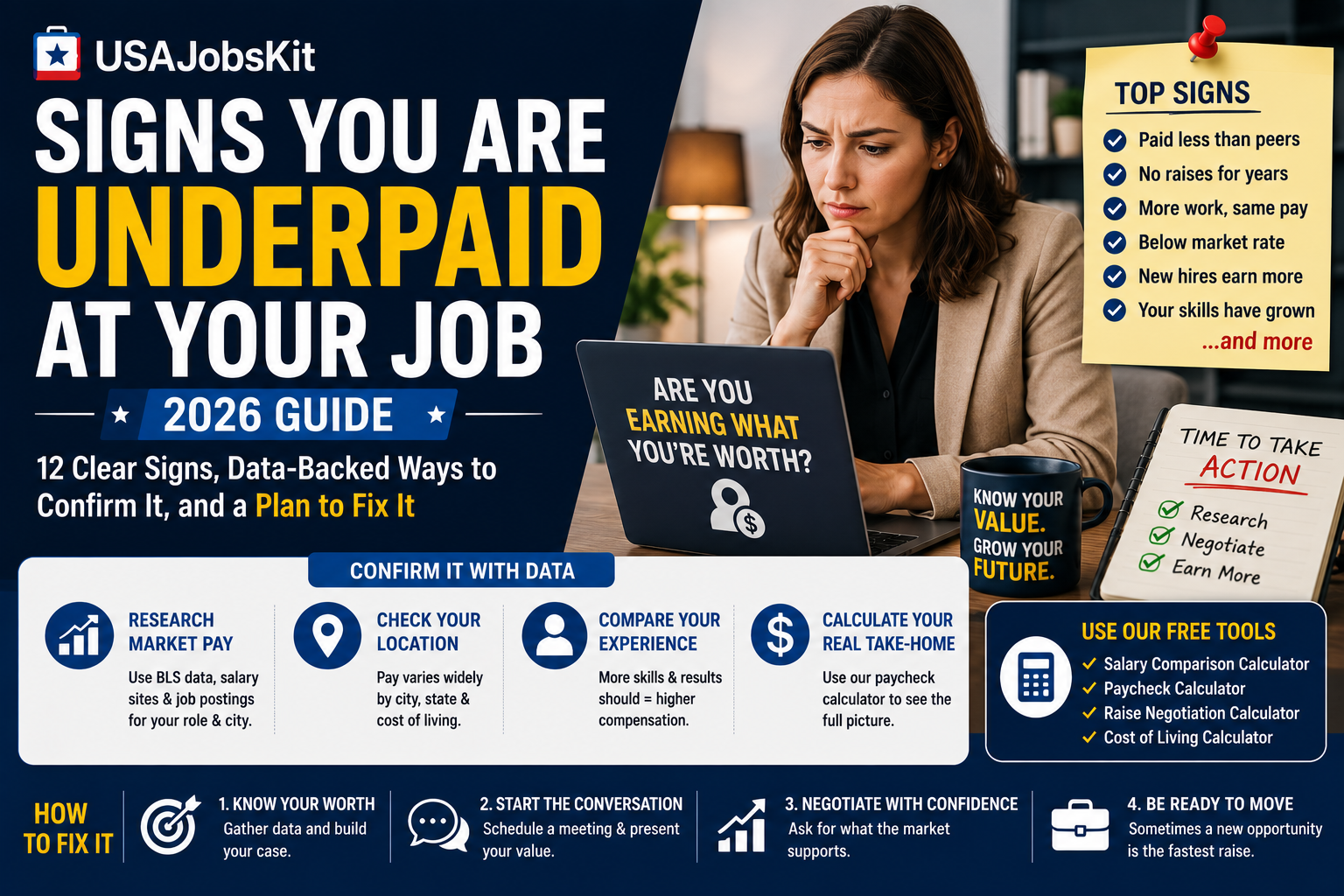
12 signs you are underpaid at your job
Your salary is below the market median for your role and city
This is the most concrete, objective sign of underpayment – and the one that holds up in any salary conversation. The BLS Occupational Employment and Wage Statistics program publishes median wages by occupation and metropolitan area. If your salary falls more than 10 to 15 percent below the median for your occupation and location, you are statistically underpaid relative to your peers doing the same work in the same market. Use the how much should you earn tool to run this comparison against current data for your specific role and state.
New hires in similar roles are being paid more than you
This is one of the most common and frustrating underpayment scenarios. Companies routinely offer higher starting salaries to attract new candidates while existing employees’ pay stagnates. If you discover – through job postings, a colleague’s disclosure, or HR data – that people doing the same work as you with less experience are being paid more, that is a direct signal of wage compression. CareerCheck.io identifies this as the single most common sign of underpayment in its 2026 analysis. It is also the strongest argument to bring to a raise conversation, because it demonstrates internal equity failure – not just external market lag.
Your responsibilities have grown significantly but your pay has not
Job creep – where responsibilities expand over time without a corresponding title change or salary adjustment – is an extremely common underpayment mechanism. If you are regularly handling work that would require a more senior hire to replace you, or if your actual day-to-day work has materially expanded beyond the role you were hired into, your compensation should reflect your actual contribution – not the job description from your offer letter two years ago. Indeed’s analysis of underpayment signs identifies this as one of the top five indicators workers consistently overlook.
Your salary has not kept pace with inflation
A salary that stays flat is a salary that shrinks in real terms every year. US inflation between 2020 and 2026 has been significant – a salary that was competitive in 2021 may represent materially less purchasing power in 2026 even if the number has not changed. If your raises over the last three to five years have consistently been below inflation, your real wage has declined even while your nominal pay increased. The pay raise calculator helps you see how any specific raise percentage compares to inflation and what your salary would need to be today to maintain the same purchasing power it had when you started.
You have never negotiated your salary
Workers who accept initial offers without negotiating start from a lower baseline than those who negotiate – and that gap compounds with every subsequent raise, bonus, and promotion that is calculated as a percentage of the base. Research consistently shows that most employers build negotiation room into initial offers, and that candidates who negotiate starting salaries gain significantly more over a career than those who do not. If you have been in your current role for more than a year without ever having a salary conversation, the probability that you are below market is high. The salary negotiation guide walks through how to approach this conversation at any career stage.
A recruiter or job offer reveals what the market actually pays
Recruiters are a real-time signal of market salary. If a recruiter reaches out for a role similar to yours and the salary range they quote is meaningfully higher than what you currently earn, that is direct market feedback – not speculation. Similarly, if you interview elsewhere and receive an offer that is substantially above your current salary for comparable work, your current employer is paying you below what the market will bear. LinkedIn research found that workers who move jobs in strong hiring markets frequently achieve salary increases of 10 to 20 percent over those who stay, specifically because external movement prices against the current market rather than an employer’s internal pay band.
Your company is growing but your salary is not
Company revenue growth does not automatically flow to employee compensation – but consistently strong company performance with flat individual salaries is a sign that value creation is not being shared proportionally. If your employer regularly posts strong financial results, secures new funding, or grows its client base while individual salaries remain static, the organization is capturing value that its employees are contributing without passing it on. This is especially relevant for employees in roles with direct revenue impact – sales, product, engineering, or client delivery – where the connection between individual output and company growth is clearest.
You switched industries but kept the same salary
Transitioning from a lower-paying industry to a higher-paying one without renegotiating starting pay is a common way workers end up underpaid. If a new employer set your starting salary based on your previous role’s pay rather than the market rate for the new role you are performing, you may have entered your new industry already behind. This pattern is especially common when workers move from non-profit or government roles into private-sector positions, or from lower-paying regional markets into higher-paying ones. The salary range guide explains how to anchor any negotiation to the role’s market rate rather than your prior compensation history.
Your skills are in high demand but your pay does not reflect it
Skill scarcity has a direct effect on market compensation. If you hold certifications, technical proficiencies, or domain expertise that employers are actively competing for – cloud computing, cybersecurity, data science, specialized medical credentials – and your salary was set before that demand spike, your current pay may significantly lag the market for your skill set. The job posting market is one of the most current indicators of what specific skills are worth: if you search open roles requiring your key skills and the posted salary ranges are substantially above your current pay, that gap is real and documented. See the best remote jobs that pay well for a current picture of what in-demand skills command in 2026.
You have not had a performance review in over a year
Regular performance reviews serve two purposes: they assess your work, and they create structured opportunities to discuss compensation. Employers who consistently delay or skip performance reviews often do so – intentionally or not – in ways that defer salary conversations. If you cannot remember your last formal performance review, or if they occur but never include any discussion of compensation relative to your contributions or the market, you are missing the primary internal mechanism for catching and correcting underpayment. The salary negotiation guide covers how to initiate a pay conversation even in the absence of a formal review process.
Your benefits package has eroded relative to comparable employers
Total compensation includes more than base salary. If employer contributions to your health insurance have decreased, your 401(k) match was reduced or eliminated, PTO days have been cut, or remote flexibility was removed while comparable employers continue to offer these benefits, the effective value of your compensation has declined even without a salary cut. Calculate the dollar value of benefits changes the same way you would a salary cut – health insurance premium increases, reduced retirement matching, and lost PTO days all represent real income. The paycheck after 401(k) calculator helps quantify the difference a 401(k) match change makes to your effective annual compensation.
Your pay does not reflect your specialized expertise or tenure
Seniority and institutional knowledge have real market value – but employers rarely price it automatically without being asked. If you are the person others come to for answers, the one who handles the most complex problems, or the employee who would be most expensive to replace, and yet your salary sits at the same level as newer, less experienced colleagues, your compensation is not reflecting your actual value to the organization. Documenting specific contributions – projects led, problems solved, revenue influenced, systems built – is the foundation of any successful case for a market-correcting raise. The how much should you earn tool helps you anchor that case in current market data for your exact role.
How to confirm you are underpaid: a data-first approach
Suspecting you are underpaid is not the same as being able to demonstrate it. Before any salary conversation, the goal is to replace the feeling with a number backed by verifiable sources. Here is how to build that case systematically:
| Data source | What it tells you | How to use it |
|---|---|---|
| BLS OES data | Median and percentile wages by occupation and metro area | Find the 50th and 75th percentile for your occupation in your metro area – this is your documented market range |
| Job postings (Indeed, LinkedIn, Glassdoor) | Current employer salary ranges for comparable roles | Search 10–15 current postings for your role in your city; note the salary ranges and calculate the median |
| USAJobsKit salary benchmarks | Role and state-specific salary data with experience adjustments | Use the how much should you earn tool to get a targeted market figure for your specific role and location |
| Recruiter conversations | Real-time market rate from active hiring activity | Engage with relevant recruiters on LinkedIn – even if you are not actively job hunting, a 20-minute call reveals what companies are currently paying for your skills |
| Salary comparison with colleagues | Internal equity data at your specific employer | Protected under the National Labor Relations Act – you have the right to discuss salary with coworkers. Wage secrecy policies do not override NLRA rights for most private-sector employees |
Your right to discuss salary: Most private-sector employees in the US have a federally protected right under the National Labor Relations Act to discuss their pay with coworkers. Employer policies that prohibit salary discussions are generally unenforceable. You cannot be legally terminated or disciplined for discussing your salary with a colleague.
What to do once you confirm you are underpaid
Knowing you are underpaid is only useful if it leads to action. The approach depends on how large the gap is, how long you have been at the company, and how your employer typically responds to pay conversations. Here is a practical sequence:
- Quantify the gap precisely. Know the specific number – not a vague “I think I should earn more.” If the market median for your role and city is $78,000 and you earn $65,000, the gap is $13,000 or 20 percent. That specificity makes a raise request a data conversation rather than a personal one.
- Document your contributions. Compile a brief record of what you have delivered: projects completed, problems solved, revenue generated, team members mentored, cost savings achieved. The goal is a one-page summary of your value to the organization that supports the salary adjustment you are requesting.
- Request a dedicated salary review meeting. Do not anchor this conversation to a performance review or drop it casually. Request a focused meeting to discuss your compensation relative to your contributions and the market. Give your manager time to prepare – “I’d like to schedule time to discuss my compensation in the context of my current role and market data” is specific and professional.
- Come with a specific target number. Name a number, not a range. Anchoring to a specific figure – “Based on the market data I’ve researched and my contributions over the last year, I’m asking for $78,000” – gives the conversation a concrete starting point and signals preparation. The salary range guide explains how to identify and defend that number effectively.
- Give a reasonable timeline for a decision. After presenting your case, ask your manager when they can respond by. A one to two week window is reasonable and prevents the conversation from stalling indefinitely.
- Evaluate the response honestly. A partial increase that acknowledges the gap but does not fully close it may be worth accepting if the employer commits to closing it over a defined timeline. A flat refusal without a credible business reason – in a company that is financially healthy and where market data clearly supports your request – is a signal about the ceiling on your earning potential at that employer. External movement is often the most effective tool for closing a wage gap that internal negotiation cannot resolve.
Before the conversation: Run your target salary through the take-home pay calculator for your state so you know the real after-tax difference between your current pay and your target. Knowing that a $13,000 raise means approximately $800 to $900 more per month in take-home makes the stakes concrete.
When to move jobs instead of negotiate
Internal salary negotiation has limits. Some employers have rigid pay bands that cannot accommodate a market correction regardless of your performance or the data you present. Others are in financial positions that genuinely constrain immediate salary increases. And some simply do not value long-tenured employees appropriately regardless of contribution.
External movement is often the fastest and most effective way to close a significant salary gap. Workers who move jobs in a competitive market frequently achieve salary increases of 15 to 25 percent that would take years to accumulate through internal raises. The job search itself also gives you leverage – an external offer can accelerate an internal raise conversation that has been stalling, because it makes the cost of inaction concrete for your employer.
If you have had a clear, data-backed salary conversation and your employer has been unable or unwilling to close the gap meaningfully within a reasonable timeframe, the decision to move is a financial one, not a personal one. Use the resume tools, LinkedIn tools, and interview tools on USAJobsKit to get your materials ready before you start applying.
USAJobsKit tools for salary research and negotiation
How Much Should You Earn
Benchmark your current salary against market data for your specific role, city, and experience level.
Open the salary benchmark toolPay Raise Calculator
See how any percentage raise changes your annual salary, monthly pay, and per-paycheck take-home.
Open the pay raise calculatorTake-Home Pay Calculator
See what any target salary actually nets in your state after federal tax, state tax, and FICA.
Open the take-home pay calculatorSalary Calculator
Convert any annual salary into weekly, biweekly, semimonthly, and monthly breakdowns.
Open the salary calculatorResume Summary Generator
Build a focused professional summary that positions you effectively if you decide to move jobs.
Open the resume summary generatorLinkedIn Headline Generator
Update your LinkedIn profile to attract recruiters and external opportunities while you evaluate your options.
Open the headline generatorRelated reading on USAJobsKit
- How to negotiate your salary – the complete playbook for requesting a raise or negotiating a new offer
- How to set your salary range – identify and defend a specific target number before any salary conversation
- What is a good salary in the US in 2026? – national benchmarks to put your current pay in context
- How to calculate take-home pay – understand the real difference a raise makes after taxes
- Best remote jobs that pay well in 2026 – if external movement is right for you, these roles offer the strongest salary recovery
- Best entry-level jobs that pay well – starting points for those considering an industry pivot to close the salary gap
- How to answer “Why should we hire you?” – essential preparation if an external job search is your next step
- How bonuses and commissions affect pay – total compensation context for evaluating any new offer against your current package
FAQ
How do I know if I am underpaid at my job?
The clearest indicator is a measurable gap between your current salary and the market median for your specific role, experience level, and location. Research your occupation’s median pay using BLS data, current job postings, and the how much should you earn benchmarking tool. If your salary falls more than 10 to 15 percent below that median, you are statistically underpaid. Other strong signals include new hires being paid more than you for similar work, no meaningful raise in two or more years, and job offers or recruiter conversations that reveal significantly higher market rates than your current pay.
What should I do if I am being underpaid?
Start by building a data-backed case: document the market rate for your role and city, and compile a record of your specific contributions. Then request a dedicated salary review meeting – not a casual mention in a hallway – and come with a specific target number supported by market data. If your employer declines without a credible reason in a financially healthy company, consider whether external movement is the faster path to correcting the gap. The salary negotiation guide covers the full approach step by step.
Is it common to be underpaid?
Yes. Underpayment is widespread, particularly among workers who have stayed in the same role for several years without external benchmarking, who accepted initial offers without negotiating, or who changed industries without renegotiating starting pay. Career Contessa research found that feeling underpaid doubles the probability of experiencing stress and depression at work on a majority of workdays. The combination of financial impact and wellbeing impact makes identifying and addressing underpayment worth prioritizing.
How much of a raise should I ask for if I am underpaid?
The raise you request should close the gap between your current salary and the market median – not follow the standard 3 to 5 percent annual raise convention. That convention is for employees already at market rate, not a correction tool for underpayment. If your current salary is $58,000 and the market median for your role and city is $72,000, asking for $72,000 to $75,000 is a defensible, data-backed position. Use the pay raise calculator to see what percentage increase that represents and how it changes your monthly take-home.
Can I be underpaid even if I got a raise last year?
Yes. A raise raises your baseline but does not necessarily close an existing gap with the market. If your salary was 15 percent below market before a 3 percent raise, you are still 12 percent below market after it. The relevant question is always whether your current salary matches what the market pays for your role, skills, and location today – not whether the number went up. Use the how much should you earn tool to check the gap independently of recent raise history.
Sources
- Indeed – 20 Signs You’re Underpaid and What to Do About It
- Career Contessa – 27 Signs You’re Being Underpaid at Work and What to Do About It
- CareerCheck.io – 7 Signs You’re Underpaid (And Exactly What to Do About It), February 2026
- Bureau of Labor Statistics – Occupational Employment and Wage Statistics
- Forbes – Ten Signs You’re Underpaid
Final takeaway
Being underpaid is not a permanent condition – it is a gap between your current salary and what the market will pay for your skills, experience, and role. That gap can be closed, but only by first confirming it with data and then addressing it with a specific, documented request. The most important step is starting: benchmark your salary now, before the next performance review, before the next annual raise conversation, and before you spend another year below the market rate for the work you are already doing.
Use the how much should you earn tool as the starting point, the salary negotiation guide to prepare your case, and the take-home pay calculator to understand what closing the gap would actually mean for your bank account after taxes.
Find out if you are being paid what you are worth
Benchmark your salary against market data for your role and location – then see what a raise to market rate would net after taxes.
Disclaimer: This article is for general educational and informational purposes only. Salary benchmarks and market data cited reflect publicly available sources as of 2026 and vary by employer, industry, location, and individual circumstances. Nothing in this article constitutes legal, employment, or financial advice. If you believe you are subject to wage discrimination or illegal pay practices, consult an employment attorney or contact the relevant regulatory authority.