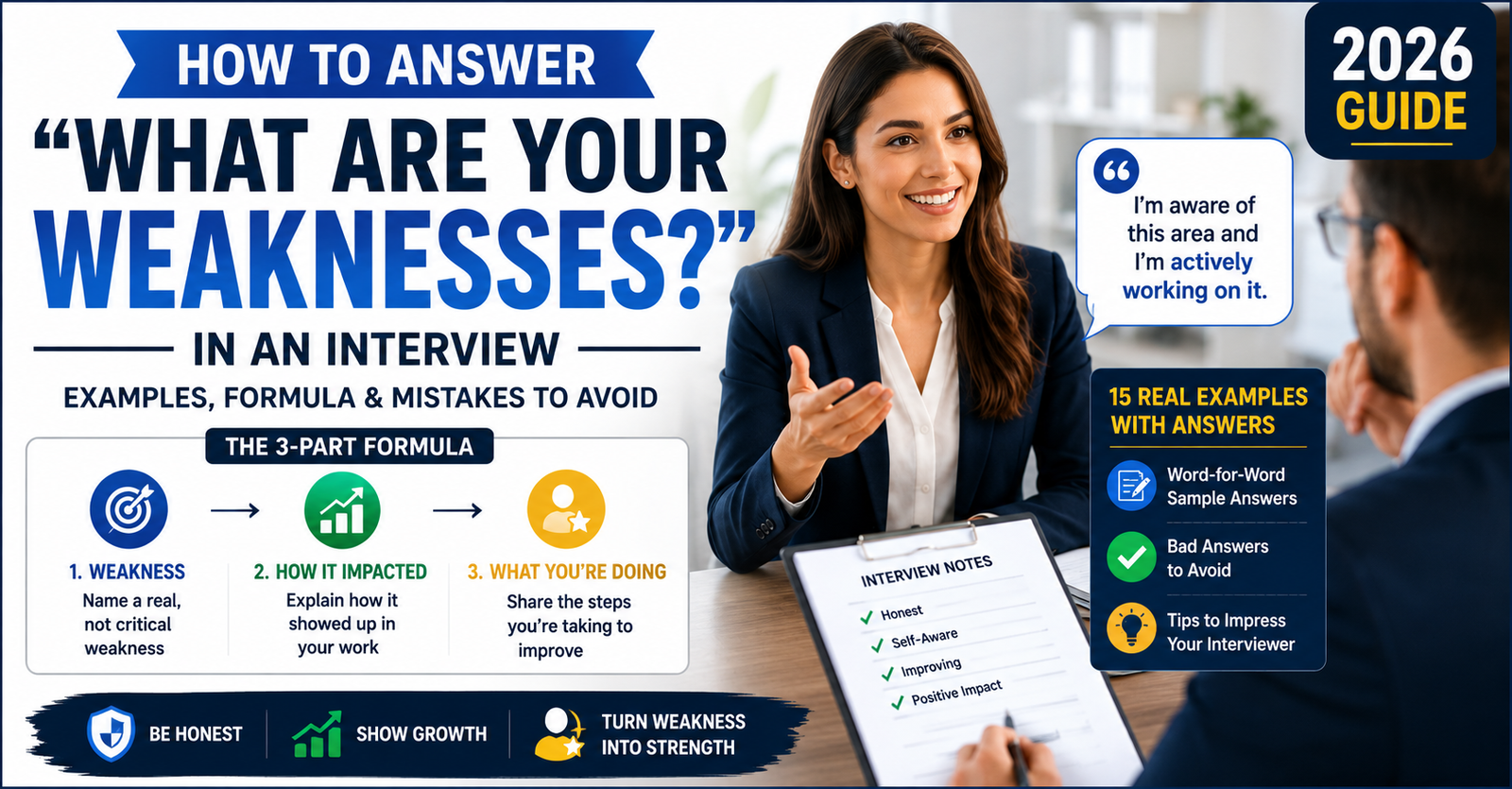
The weaknesses question trips up more candidates than almost any other interview question not because it’s hard, but because most people approach it with the wrong goal. They either fake a strength disguised as a weakness, panic and overshare something genuinely damaging, or deflect with a non-answer that tells the interviewer they’re not self-aware. This guide shows you the exact 3-part formula that works, gives you 15 real weakness examples with word-for-word sample answers, and explains precisely what makes a weakness answer succeed or fail in a US job interview.
Why Interviewers Ask This Question
Understanding what a hiring manager is actually evaluating when they ask this question changes how you answer it. They are not trying to find a reason to eliminate you. They already know every candidate has weaknesses. What they’re assessing is something more specific and more important.
- Self-awareness. Professionals who can accurately identify their own limitations are easier to manage, more coachable, and less likely to become a problem on the team. Candidates who claim to have no weaknesses or give fake answers signal that they lack the self-awareness to do either.
- Honesty. Interviewers sit across from candidates all day long. They have finely tuned radar for answers that are rehearsed deflections versus genuine reflection. A candidate who gives an honest, thoughtful answer about a real limitation builds far more trust than one who performs a scripted non-answer.
- Growth orientation. US hiring managers are not just evaluating where you are today. They’re evaluating your trajectory. A candidate who identifies a real weakness AND describes the specific steps they’ve taken to address it demonstrates a growth mindset that signals long-term potential.
- Fit for the role. In some cases, the interviewer genuinely wants to know whether your weakness could affect your performance in this specific role. The choice of which weakness you share matters because it communicates what you understand about the job’s demands.
You are not trying to hide your weaknesses. You are trying to demonstrate that you know yourself well enough to name a real one, that you take ownership of it without making excuses, and that you’re actively doing something about it. That combination signals maturity, professionalism, and coachability. Those three qualities are far more valuable to a hiring manager than a candidate who claims to be without flaws.
The 3-Part Formula for a Strong Weakness Answer
Every strong weakness answer follows the same three-part structure. The formula is simple to understand and straightforward to apply once you have the right weakness chosen.
The third part is the most important and the most commonly left out. Most candidates identify a weakness and describe it, then stop. The interviewer is left with an incomplete picture that ends on a negative note. Part 3 converts the answer from a confession into a demonstration of growth. It’s what separates a memorable, positive answer from a forgettable or damaging one.
Part 1 (Name It): “One area I’ve had to work on is delegating effectively.”
Part 2 (Show It): “Earlier in my career, I had a tendency to hold on to tasks I felt were high-stakes rather than trusting my team to execute them. It slowed projects down and limited my team’s development.”
Part 3 (Fix It): “I’ve addressed this deliberately over the last two years by setting explicit ownership at the start of each project and scheduling check-ins rather than monitoring constantly. Two of my direct reports have since taken on responsibilities they’re now leading independently, and our sprint velocity improved by 30%.”
Notice what this answer does not do. It does not apologize excessively. It does not qualify the weakness out of existence. It does not end on a low note. It states the weakness honestly, gives it real context, and then pivots to evidence of growth with a specific result. That structure is what every strong weakness answer follows.
15 Good Weakness Examples With Sample Answers
Each of the following weaknesses is real, specific, and suitable for a US job interview. They are organized by category and each includes a word-for-word sample answer following the 3-part formula. Adapt the details to your own background before using them.
“One weakness I’ve actively worked on is delegating effectively. Earlier in my career I held on to high-priority tasks rather than trusting my team, which created bottlenecks and limited their development. Over the past two years I’ve started assigning clear ownership at the project kickoff and stepping back from daily check-ins. As a result, two team members have grown into roles they now lead independently, and our average project delivery time improved noticeably.”
“I used to find large-group presentations genuinely uncomfortable, which held me back from volunteering for speaking opportunities I was otherwise qualified for. I recognized it was limiting my visibility, so I joined a local Toastmasters chapter about 18 months ago and have presented at our all-hands meeting three times since. I’m still not the most natural speaker in the room, but I no longer avoid it, and the feedback from my last company-wide presentation was specifically positive.”
“I can get impatient when processes move slower than I think they need to, which I’ve had to manage carefully in larger organizations with more approval layers. I’ve learned that pushing too hard can damage relationships and slow things down more than the process itself. What I’ve done differently is invest earlier in getting stakeholder alignment before execution, which reduces the friction I used to run into mid-project. That shift has made me more effective and easier to work with.”
“I’ve historically found it difficult to turn down requests from colleagues, which sometimes led to overcommitment and quality suffering on my primary projects. I realized that saying yes to everything was actually letting people down in a different way. I started using a simple prioritization framework to evaluate requests against my core deliverables before committing, and I’ve gotten more comfortable saying ‘not right now, but here’s when I can help’ rather than an immediate yes that I couldn’t deliver on.”
“My experience with Tableau has been more limited than with other BI tools. I’ve done most of my data visualization work in Looker, so there’s a learning curve. I’ve spent the past six weeks working through Tableau’s official training path and building practice dashboards using public datasets. I’m not yet at the level I am with Looker, but I’m getting there quickly and I’m comfortable enough now to start using it in a real project context.”
“I tend to over-document and over-explain, which comes from wanting everyone to have full context. But I’ve learned that not every stakeholder needs the same level of detail, and too much information can actually obscure the key point. I’ve started writing executive summaries at the top of every document and asking myself before I send anything whether the length matches the decision it’s supporting. The feedback I get on my communications has been noticeably more positive since I made that shift.”
“I’ve had a pattern of taking on more than I could realistically deliver rather than raising capacity concerns early. I wanted to be seen as someone who could handle anything, but the result was that I sometimes delivered late or below the quality I’m capable of. I’ve gotten much better at communicating proactively when my plate is full and working with my manager to reprioritize before a problem develops rather than after it does.”
“I work best with clear goals and defined success criteria, so early in my career I found highly ambiguous situations genuinely uncomfortable. I’ve come to recognize that ambiguity is a constant in most professional environments, especially at early-stage companies. I’ve developed a personal practice of building my own structure when it doesn’t exist: defining a working hypothesis, identifying the first two or three concrete actions, and running small experiments to reduce uncertainty rather than waiting for clarity that may not come.”
“I used to avoid giving critical feedback to peers directly, preferring to work around problems rather than address them head-on. I recognized it was creating tension rather than resolving it. I’ve read extensively on direct communication and practiced having those conversations in lower-stakes situations first. I’m now much more comfortable initiating feedback conversations, and I’ve found that most people actually appreciate the directness once the relationship is strong enough to hold it.”
“I do my best work in focused blocks, so frequent context-switching between unrelated tasks can reduce my quality and slow me down. In high-interrupt environments, I’ve found that batching similar tasks together and setting specific focus periods has helped significantly. I also communicate my working style to managers upfront so we can structure my week in a way that protects deep work time while remaining responsive when it matters.”
“My direct management experience has been with teams of four to six people, so leading a team of the size described in this role would be a step up. I’ve been preparing for this deliberately: I’ve completed a management training program, and I’ve taken on cross-functional coordination responsibilities that involved influencing 15 to 20 people without formal authority. I’m confident in my management fundamentals and excited about developing at the next level.”
“I hold myself to high standards, and when I fall short of them I tend to be hard on myself longer than is useful. I’ve worked on this by adopting a more structured post-mortem habit: I document what happened, what I would do differently, and what I can actually control going forward. That process helps me extract the lesson and move on rather than dwelling. It’s made me faster to recover and more resilient under sustained pressure.”
“I’ve historically underestimated how long complex projects take, particularly when they involve dependencies outside my direct control. This led to a few missed internal deadlines early in my career. I now build estimates by breaking projects into component tasks, estimating each individually, and adding a 20% buffer before committing to a deadline. I also factor in historical slippage data when I have it. My on-time delivery rate has been significantly higher since I adopted that approach.”
“I’ve had a tendency to spend too long working through problems independently rather than asking for help when I’m stuck. I wanted to figure things out myself, which is sometimes the right call but not always the most efficient one. I’ve shifted my approach by setting a personal time limit: if I haven’t made meaningful progress on a blocker within two hours, I reach out to someone who can help. That change alone has cut my average problem-resolution time and improved the quality of my output.”
“My background is primarily in B2B SaaS, so healthcare technology is a new vertical for me. I know the regulatory environment and the sales cycle are meaningfully different. I’ve spent the past three months reading extensively about HIPAA compliance, studying the healthcare buyer landscape, and speaking with two former colleagues who made a similar transition. I don’t have the industry depth your best candidates might have yet, but I come in with a very strong foundation in the underlying skills and genuine motivation to close that gap quickly.”
🎯 Practice Your Interview Answers
Use the USAJobsKit Interview Prep Tool to practice your weakness answer and get feedback personalized to your role and target industry.
Use Free Interview Prep Tool →Which Weaknesses Are Safe to Mention
Not all weaknesses are equal in an interview context. Some are genuinely safe to mention because they are real, relatable, and clearly separate from the core competencies the role requires. Others are risky or should be avoided entirely because they raise serious doubts about your ability to do the job.
| Category | Examples | Safety Level |
|---|---|---|
| Soft Skills (Non-Core) | Public speaking, delegating, saying no, giving peer feedback, asking for help | Safe |
| Working Style Preferences | Discomfort with ambiguity, preference for deep focus, over-documentation | Safe |
| Specific Technical Gaps | Limited experience with a non-core tool, unfamiliar with a secondary system | Safe (if not a core requirement) |
| Leadership Development Areas | Managing larger teams, executive communication, mentoring junior staff | Safe (for individual contributors stepping up) |
| Industry or Domain Knowledge | New to a vertical, unfamiliar with regulatory environment | Situational (depends on how central it is) |
| Core Role Competencies | Any weakness that is a primary requirement listed in the job description | Avoid |
| Character or Integrity Issues | Temper, dishonesty, unreliability, difficulty following instructions | Never Mention |
Before your interview, re-read the job description and identify the three or four most critical competencies the role requires. Whatever weakness you choose must sit clearly outside those core requirements. A copywriter saying “I struggle with data visualization” is safe. A data analyst saying the same thing is a red flag. A project manager saying “I find it hard to meet deadlines” is disqualifying. Choose a weakness that is honest and real, but that tells the interviewer it won’t affect your ability to do the most important parts of this specific job.
7 Weakness Answers That Instantly Hurt Your Chances
These are the seven most common weakness answers that US hiring managers see repeatedly and consistently evaluate negatively. All of them are avoidable.
The Fake Strength Disguised as a Weakness
“I just work too hard. I really struggle with leaving the office on time.”This is the most recognized deflection in every interviewer’s playbook. It signals that you’re either dishonest or not self-aware enough to identify a genuine limitation. Interviewers find it dismissive and it actively damages trust. Every candidate who says this thinks they’re being clever. Every interviewer knows exactly what they’re doing.
The Perfectionism Non-Answer
“I’m a perfectionist. I can’t stop until everything is exactly right.”This answer is so overused that it has become meaningless. Beyond that, it’s a variation of the fake strength disguised as a weakness. Hiring managers hear this in the majority of interviews. It tells them nothing about you and signals a lack of originality and honesty. If you actually do struggle with perfectionism, frame it specifically: describe when it slowed a project down and what you changed as a result.
Claiming You Have No Weaknesses
“I honestly can’t think of any real weaknesses. I’m pretty well-rounded.”This is worse than giving a bad answer. It tells the interviewer that you either lack self-awareness entirely or that you’re unwilling to be honest in a professional conversation. Both interpretations are serious red flags. Every experienced professional has identifiable areas for growth. Refusing to name one signals a lack of the self-awareness that makes people coachable and effective on teams.
Mentioning a Core Job Requirement as Your Weakness
“I’ve always had a hard time staying organized and managing my time.”Saying this when applying for a project manager, operations, or executive assistant role is an immediate signal that you don’t understand the job’s demands. Always check which competencies are central to the role before selecting your weakness. If time management or organization is a listed requirement, do not use it. Find a weakness that sits genuinely outside the core scope of the position.
Oversharing a Serious Personal or Character Flaw
“I have a short temper and I’ve had conflicts with coworkers because of it.”There’s a difference between honesty and self-sabotage. Weaknesses related to temper, reliability, honesty, or interpersonal conflict are not appropriate interview disclosures regardless of how much work you’ve done to address them. The goal of this question is to demonstrate self-awareness and growth in a professional context. Keep the weakness in the domain of skills, habits, and working styles, not character traits that affect how trustworthy or safe you are to work with.
Giving a Weakness With No Improvement Story
“I really struggle with public speaking. I’ve always been shy in front of groups.”This answer identifies a real weakness, which is good. But it ends there, with no indication that anything has changed or is changing. Without the third part of the formula, the answer confirms a limitation without demonstrating growth. The interviewer is left with a negative note at the end of your response. Always close with the specific step you’ve taken to address the weakness and the progress it’s produced.
Giving a Vague, Unverifiable Answer
“I’m working on my communication skills and just trying to be a better team player.”This is too broad to mean anything. Communication and teamwork are umbrella terms that cover dozens of specific behaviors. What aspect of communication? In what situations? What specifically did you change and what happened because of it? Vague answers signal that you haven’t thought carefully about the question. Interviewers respond to specificity. A specific, honest answer about one concrete limitation with one concrete improvement step will always outperform a polished-sounding but empty generality.
Variations of This Question to Prepare For
Interviewers ask about weaknesses in several different ways. The same 3-part formula applies to all of them. Prepare your core weakness answer and you can adapt it to any of the following phrasings.
- “What is your biggest weakness?” The classic version. Use the full 3-part formula with a real weakness and a clear improvement story.
- “What do your colleagues say you need to work on?” A 360-degree version. Answer as if you’re citing feedback you’ve genuinely received. “My manager has noted that I sometimes move faster than the team can follow” is a real, credible, specific answer.
- “Tell me about a skill you’re still developing.” A softer version that invites you to frame a weakness as a growth area. The formula is identical, but the framing naturally lands on progress rather than limitation.
- “What would your last manager say you need to improve?” Slightly different angle, same approach. Frame your answer as reflecting genuine feedback you’ve received rather than something entirely self-generated.
- “What has been the most challenging thing for you to learn in your career?” A retrospective version. Choose a skill or behavior that was genuinely difficult and describe how you developed it over time.
- “Where do you see the most room for growth in your professional development?” A forward-looking version. You can include a weakness you’re currently working on as well as a skill area you intend to develop in this role.
Some interviewers ask this question more than once in different forms, or ask a follow-up after your first answer: “Is there anything else you’d like to improve?” Preparing two distinct, real weakness answers, both following the 3-part formula, means you’re never caught off guard. Choose weaknesses that are different in category: one skill-based and one style-based is a strong combination that shows range without redundancy.
✅ Key Takeaways
- Interviewers ask about weaknesses to assess self-awareness, honesty, and growth orientation, not to find a reason to eliminate you
- Use the 3-part formula: Name It (a real, specific weakness) + Show It (a brief example of its impact) + Fix It (the specific action you took and the result)
- The Fix It part is the most important and most commonly left out. Always close on evidence of growth, not on the weakness itself
- Choose a weakness that is real and honest but clearly outside the core competencies required for the role you’re applying for
- Never use “I work too hard,” “I’m a perfectionist,” or “I don’t have any weaknesses.” All three damage your credibility immediately
- Never mention character flaws, temper, reliability issues, or interpersonal conflict as your weakness in a professional interview
- Specificity is everything. A specific weakness with a specific improvement story always outperforms a vague, polished-sounding non-answer
- Prepare two different weakness answers before every interview in case you’re asked a follow-up or the question is asked in a different form