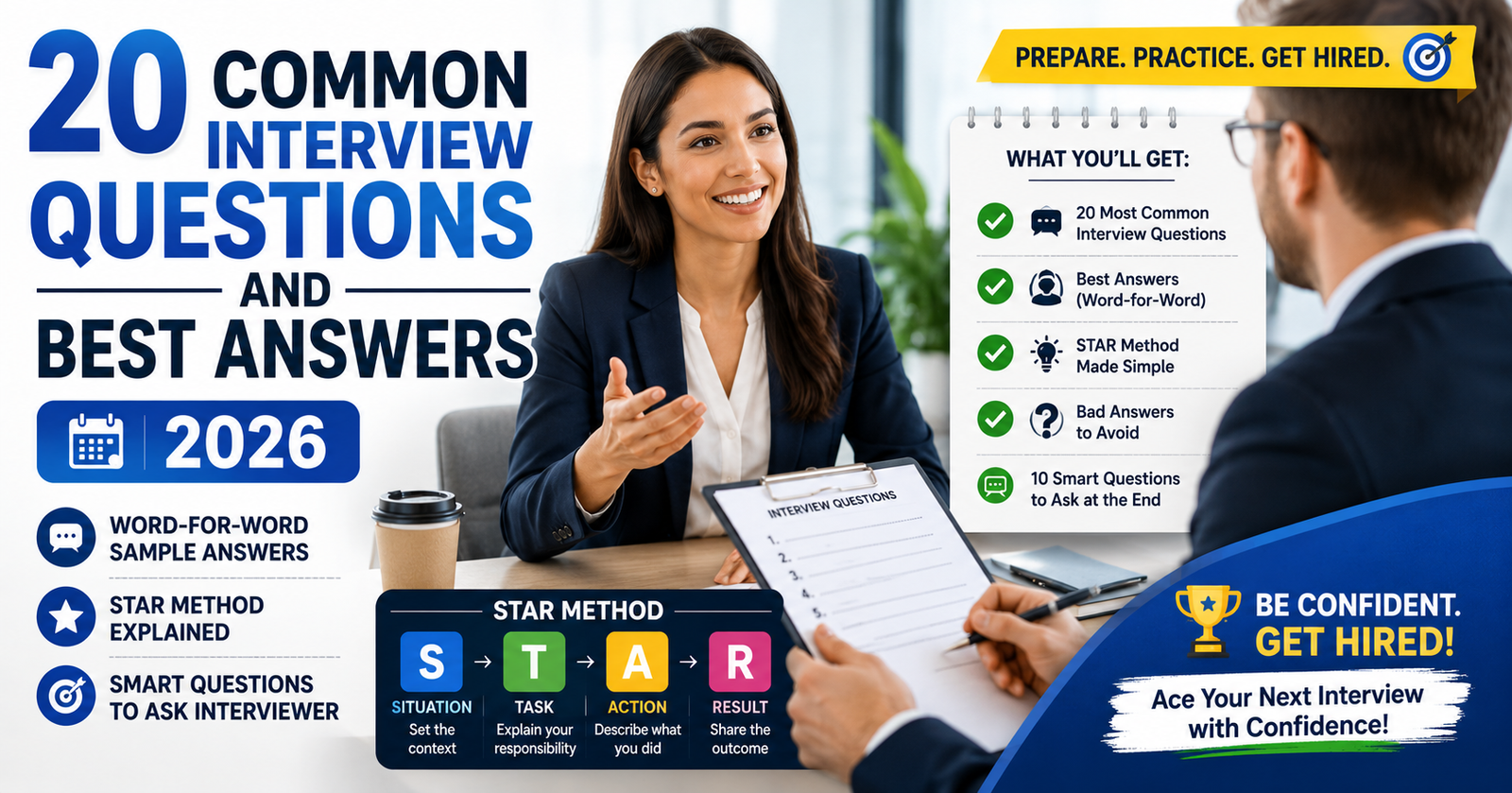
The same 20 interview questions appear in over 90% of US job interviews yet most candidates walk in underprepared, give vague answers, and leave the room unsure how they did. This guide gives you the exact framework for answering each question, word-for-word sample responses you can adapt to your own background, the answers hiring managers don’t want to hear, and the 10 smart questions to ask at the end that signal you’re the serious candidate in the room.
The STAR Method — How to Answer Any Behavioral Question
The STAR method is the most reliable framework for answering the behavioral questions that appear in almost every US interview. Instead of speaking in generalities (“I’m a good communicator”), the STAR method forces you to anchor your answer in a real, specific story — which is far more credible and far more memorable to an interviewer.
Most candidates use the STAR method but stop at the Action — they describe what they did without saying what happened because of it. The Result is what converts your story from a job description into an accomplishment. Always close your STAR answer with a specific outcome: a number, a percentage, a timeline, a business impact, or a direct consequence of your action. “We improved the process” tells an interviewer nothing. “We cut processing time by 40%, saving 12 hours per week” tells them everything.
Opener Questions (Q1–Q5)
These questions appear in almost every first-round interview. They’re designed to warm up the conversation and assess your communication clarity, self-awareness, and preparation level.
- Present: Your current role and most relevant responsibility
- Past: The experience that built your most relevant skill
- Future: Why this role is your logical next step
“I’m currently a Senior Marketing Manager at a mid-size SaaS company, where I lead a team of four and own our demand generation strategy. Before that, I spent three years in content marketing at a digital agency, which is where I developed a deep foundation in SEO and paid distribution. I’m looking to move into a Director-level role where I can shape strategy more broadly — and based on what I’ve read about your team’s growth goals, this role looks like exactly the right next step.”
Reciting your entire resume chronologically from college to today. Keep it to 60–90 seconds and stay focused on what’s relevant to this role. Do not begin with “Well, I was born in…” or “I’ve always been a people person.”
- Company-specific: One real, specific fact about this company
- Role-specific: How this role matches where you’re headed
- Value add: What you’d bring that connects to their specific need
“I’ve been following your product roadmap since you launched the enterprise tier last year — the approach to usage-based pricing is something I worked on directly in my current role, so I have real context for both the complexity and the opportunity. I’m drawn to this role specifically because it sits at the intersection of product strategy and revenue, which is where I want to build my career. I’d also bring experience scaling that exact pricing model from 50 to 400 enterprise customers, which seems relevant to where you are right now.”
“I’ve heard great things about your company culture and I think it would be a great place to grow.” This tells the interviewer nothing specific. If you can’t name something real about the company, you haven’t done the research — and they’ll know it.
- Name one specific, relevant strength — not a list
- Back it up with a real example from your career
- Connect it to how it will benefit this role
“My greatest strength is translating data into decisions that non-technical stakeholders can act on. In my current role, I built a reporting dashboard that pulled together eight disconnected data sources into a single view — our VP of Sales went from spending four hours a week on manual reports to having real-time visibility in under five minutes. That ability to bridge the gap between data and decision-making is something I’d bring directly to this role.”
“I’m a hard worker and very detail-oriented.” These are the two most overused answers in every interview. Every candidate says this — it means nothing without a story behind it.
- Name a real weakness — not “I work too hard” or “I’m a perfectionist”
- Briefly explain when it showed up in your career
- Describe the specific step you’ve taken to address it — and the result
“Early in my career, I had a tendency to take on too much personally rather than delegating effectively — I felt like I needed to control quality on everything. I realized it was slowing my team down and limiting their development. Over the last two years I’ve been deliberate about setting clearer task ownership from the start of each project, which has helped two of my direct reports take on responsibilities they’re now leading independently.”
“I’m a perfectionist — I just can’t stop until everything is perfect.” Hiring managers have heard this thousands of times. It signals that you’re not being honest, which is worse than the weakness itself.
- Describe a realistic trajectory from this role — not a leap over it
- Show ambition without implying you’ll leave in 12 months
- Connect your goals to the company’s direction
“In five years, I see myself having grown into a senior or lead role in this area — ideally having built a strong track record on this team and taken on broader responsibilities as the company scales. I’m genuinely interested in the problem space you’re working in, so I’m looking for somewhere I can invest for the long term rather than treat as a stepping stone. The growth trajectory I’ve read about here suggests there would be room to grow as the business does.”
“Honestly, I just want to find something stable for now.” This signals lack of ambition and that you haven’t thought seriously about the role. Equally, don’t say “I’d like to be in your position” — it’s presumptuous and puts the interviewer in an awkward position.
Behavioral Questions (Q6–Q11)
These questions ask you to describe what you did in a past situation. They always begin with “Tell me about a time…” or “Describe a situation when…” Use the STAR method for every one of these.
- Situation: Set the context — what was the project, team, or environment?
- Task: What was your responsibility in solving it?
- Action: Specifically what did you do — not “we,” but “I”?
- Result: What happened as a direct result of your actions? Add a number.
“In Q3 last year, our main software vendor had an unexpected outage three days before a client demo that represented a $400K contract. I immediately pulled together the engineering lead and account manager to assess what we could rebuild manually in 72 hours. I prioritized the three features the client had specifically asked about, rebuilt them in a lightweight staging environment, and briefed the client directly on the situation. We ran the demo successfully, the client appreciated the transparency, and we closed the contract on schedule.”
Describing a challenge that was caused by someone else and focusing on how frustrating that person was. Keep the story centered on your actions and your result — not on blaming teammates or external circumstances.
- Choose a story where your specific contribution was clear and meaningful
- Describe how you worked with others — not just that you “collaborated well”
- End with an outcome that shows the team succeeded partly because of your role
“I was part of a cross-functional team tasked with launching a new onboarding flow that involved product, engineering, design, and customer success. The teams had different priorities and the project kept stalling in handoffs. I volunteered to create a shared project tracker that mapped each team’s dependencies and set joint deadlines — it gave everyone visibility and removed the ambiguity that was causing delays. We launched four weeks ahead of the original timeline and saw a 28% improvement in trial-to-paid conversion in the first 30 days.”
Saying “we did everything together” without specifying your individual role. Interviewers are evaluating you, not your team. If your contribution isn’t clear, the answer doesn’t work.
- Choose a real mistake — not a trivial one, but not a catastrophic one either
- Take full ownership — no qualifiers, no blaming others
- Describe what you specifically learned and changed as a result
“Early in a product launch cycle, I underestimated the scope of a third-party integration and didn’t flag the risk to stakeholders early enough. When the delay surfaced two weeks before launch, we had to push the date and reset client expectations. I took responsibility directly with the client and with leadership. What I changed going forward was building a formal risk log into every project kickoff — I now document all external dependencies and share it with stakeholders in the first week. I haven’t had a surprise like that since.”
“I once made a minor typo in an email.” Trivial mistakes signal you’re avoiding the question. Interviewers want to know how you handle real failure — not that you’re unwilling to discuss it.
- Choose a conflict that was about work — not personality clashes or gossip
- Show that you addressed it directly rather than going around the person
- End with a resolution that preserved the working relationship
“A peer in engineering and I had a recurring disagreement about prioritization — I was advocating for a feature my customers needed urgently, and he felt it would create significant technical debt. Rather than escalating to our manager, I asked for a one-on-one and we walked through the business case and the technical concerns together. We landed on a phased approach that addressed the immediate customer need while scheduling a refactor in the next sprint. It actually strengthened our working relationship because we both felt heard.”
Describing a conflict where you were entirely right and the other person was entirely wrong. Interviewers know real workplace conflicts rarely work that way — a black-and-white story signals poor self-awareness.
- Describe a genuine time crunch — not “I had a lot going on”
- Show the specific method you used to prioritize and execute
- End with the successful outcome and ideally a lesson you carried forward
“During our annual product launch last year, two of my team members called out sick the same week we were finalizing copy, assets, and email sequences for a campaign reaching 80,000 contacts. I triaged every task by business impact and deadline, reassigned three deliverables to freelancers I had on retainer, handled the highest-stakes copy myself, and pushed back one low-priority asset with stakeholder agreement. The campaign launched on schedule, hit a 26% open rate — our highest of the year — and generated 340 qualified leads in the first 48 hours.”
Vague answers: “I just made a list and worked through it.” This tells the interviewer nothing about how you actually think. Be specific about the method, the decisions, and the result.
- Choose an achievement that is both impressive AND relevant to this role
- Give the full STAR context so the interviewer understands the difficulty
- Lead with the result — then walk backward through how you got there
“The achievement I’m most proud of is building our customer success function from zero to a team of seven in 18 months. When I joined, there was no formal post-sale process — customers churned within 90 days at a 34% rate and no one owned the relationship after close. I designed the onboarding playbook, hired and trained the team, and implemented a health score framework in Salesforce. Within 12 months, churn dropped to 9% and NPS climbed 41 points. That work directly contributed to a Series B raise the following quarter.”
Choosing an achievement that happened a long time ago or is unrelated to the role. Always pick the story that makes you most relevant to the job in front of you — not the one you’re most personally proud of.
Tricky Questions (Q12–Q16)
These questions feel designed to trip you up — and without preparation, they often do. Each one has a clear right approach and common wrong answers that hiring managers recognize immediately.
“I’ve genuinely learned a lot in my current role and I’m proud of what the team has accomplished. I’m at a point where I’ve reached the ceiling of what I can grow into there — the structure doesn’t have a path to the kind of strategic work I want to be doing. I’m looking for a role where I can take on broader ownership and work at a company that’s at an earlier, faster-moving stage. That’s what drew me to this opportunity.”
Criticizing your current manager, company, or colleagues — no matter how justified it feels. Negativity about a former employer makes interviewers wonder if you’ll talk about them the same way. Always frame your departure as moving toward something, not away from something.
“I took 14 months away from full-time work to care for a family member who was seriously ill. It was the right decision and I have no regrets about making it. During that time, I stayed current in the field by completing a Google Project Management certification and following industry developments closely. I am fully available now and genuinely ready to bring my full focus to a new role.”
Being defensive, overly apologetic, or giving an evasive non-answer. Address it directly, briefly, and confidently — then pivot to your readiness and what you did during the gap. Gaps explained proactively almost never disqualify a candidate.
“Because I’ve done the specific work this role requires — not a version of it, but exactly this. I’ve scaled a B2B demand generation program from $2M to $8M in pipeline, built and managed the team that ran it, and done it at a company at the same stage of growth you’re at now. I’m also genuinely excited about the problem you’re solving, which matters because I do my best work when I care about the outcome. I don’t think you’ll find many candidates who combine that specific experience with this level of enthusiasm for where you’re headed.”
“I’m a hard worker, fast learner, and team player.” Every candidate says this — it means nothing without specific evidence. Be direct and specific about what you bring that others don’t.
“I handle pressure by getting more structured, not less. When things get intense, I break the problem into its most important components, set explicit priorities, and communicate clearly with the people around me so no one is guessing. I’ve been in high-pressure situations — launching a product while two team members were out, managing a client relationship through a critical outage — and what I’ve found is that clear thinking and clear communication calm the situation more than any specific technical skill. Stress by itself doesn’t affect my performance — what I try to prevent is ambiguity, because that’s what actually slows teams down.”
“I don’t really get stressed.” This signals either dishonesty or a lack of self-awareness — both are red flags. Every professional experiences pressure. The question is how you manage it.
“Based on my research into market rates for this role in [City] and my level of experience, I’m targeting a range of $95,000 to $110,000 in base compensation. That said, I’m open to a conversation — total compensation matters to me, so I’d want to understand the full package including equity, benefits, and any performance-based components before drawing a hard line.”
“I’m flexible — whatever you think is fair.” This leaves you entirely at the employer’s mercy and signals you haven’t researched the market. Always give a researched range rather than no number at all. For a full salary negotiation guide, see How to Negotiate Salary After a Job Offer.
Closer Questions (Q17–Q20)
These questions appear at the end of most interviews. They’re designed to assess your fit, your intentions, and whether you’ve thought seriously about the role.
“What motivates me most is seeing a direct line between the work I do and a real outcome — whether that’s a customer getting more value, a team hitting a goal, or a product solving a problem it didn’t solve before. I’m also motivated by working with people who are genuinely good at what they do — being around that level of competence raises my own game. From what I’ve learned about this team, I think both of those things are present here.”
“I’m motivated by money and career advancement.” Even if this is partially true, it signals that your motivation is entirely extrinsic — and that a better offer would pull you away at any moment. Focus on intrinsic motivations that connect to the actual work.
“Structured, direct, and curious. Structured because I work best when there’s a clear plan and measurable goals — even in ambiguous situations I build that structure myself. Direct because I believe clear communication saves everyone time. And curious because I ask a lot of questions before jumping to solutions — it’s something my teams have told me they appreciate because it prevents us from building the wrong thing.”
“Hardworking, dedicated, and passionate.” These three words are on 80% of LinkedIn profiles and tell the interviewer nothing distinctive about you. Pick words that are specific to how you actually work.
“In the first 30 days, I’d focus on listening — understanding how the team operates, building relationships with key stakeholders, and mapping the current state before making assumptions. In days 30 to 60, I’d identify the two or three areas where I could add value quickly and propose a concrete plan with measurable goals. By day 90, I’d want to have delivered at least one visible result that shows I understood the priority and executed against it. I’d also want to have a clear view of the longer-term roadmap and how my role contributes to it.”
“I’d just try to learn as much as possible and meet people.” This is too passive for most professional roles. Hiring managers want to see initiative and a plan — not a promise to observe quietly for three months.
“I’d just like to reiterate how genuinely excited I am about this opportunity. After this conversation, I’m even more confident that the work your team is doing is exactly where I want to be. I bring [specific skill or experience most relevant to the role discussed], I’m ready to contribute quickly, and I’d welcome the chance to continue this conversation. Thank you for the time — I hope to hear from you soon.”
“No, I think we’ve covered everything.” This is a missed opportunity. Always use this moment to reaffirm your interest, reinforce your fit, and leave the interviewer with a confident, positive final impression.
🎯 Practice Your Interview Answers
Use the USAJobsKit Interview Prep Tool to practice answering common interview questions with AI feedback — personalized to your role and industry.
Use Free Interview Prep Tool →10 Smart Questions to Ask Your Interviewer
When the interviewer asks “Do you have any questions for us?” the wrong answer is no. Saying you have no questions signals disinterest or lack of preparation. The right questions show that you’re thinking seriously about the role, the team, and the company — and they give you real information to decide if this is the right opportunity for you.
- “What does this company do?” — You should know this already. Asking it signals zero preparation.
- “How much vacation time would I get?” — Save compensation and benefits questions for the offer stage.
- “Can I work remotely full-time?” — If remote policy wasn’t discussed, this signals the job is secondary to the arrangement.
- “When will I be up for a promotion?” — Premature in a first interview and signals your focus is on advancement, not contribution.
Day-Of Interview Preparation Tips
Prepare 5–7 STAR Stories
Build a bank of versatile stories that cover challenge, failure, teamwork, leadership, conflict, and achievement. One strong story can be adapted for multiple questions.
Research Before You Walk In
Know the company’s product, their most recent news, their business model, and the name of your interviewer. 15 minutes of research separates prepared candidates from everyone else.
Time Your Answers
Most interview answers should run 60–120 seconds. Practice out loud — not in your head. What feels complete in your head often runs 3+ minutes when spoken.
Bring Copies of Your Resume
Bring 3–5 printed copies to in-person interviews. Use the same resume you submitted. Having it in front of you prevents fumbling for dates or titles under pressure.
Use Numbers Wherever Possible
Every STAR story should end with a number, percentage, dollar amount, time saved, or other quantified result. Numbers make accomplishments real and memorable.
Send a Thank-You Email Within 24 Hours
Email each interviewer within 24 hours. Reference something specific from the conversation, reiterate your interest, and keep it to 3–4 sentences. Most candidates skip this step — which means doing it immediately sets you apart.
✅ Key Takeaways
- The same 20 questions appear in over 90% of US interviews — preparing specific, structured answers for each one is the highest-ROI interview prep activity
- Use the STAR method (Situation, Task, Action, Result) for every behavioral question — always close with a quantified result
- Never criticize former employers, managers, or colleagues — frame every departure as moving toward opportunity
- Give a researched salary range rather than “I’m flexible” — know the market before the interview
- Address employment gaps directly, briefly, and confidently — then move on to your readiness
- Always ask 2–3 thoughtful questions at the end — saying you have no questions signals disinterest
- Prepare 5–7 versatile STAR stories that can be adapted to multiple question types
- Practice out loud — not in your head. Timing and flow only become clear when you actually speak the words
- Send a personalized thank-you email within 24 hours of every interview