
How Your Pay Schedule Affects Your Budget in 2026
Quick Answer
Your pay schedule determines how often money lands in your account, and that directly shapes how you plan bills, savings, and spending. Weekly pay gives you frequent cash flow but smaller checks. Monthly pay gives you one large deposit but demands strict planning over a 30-day gap. Biweekly and semimonthly schedules fall in between and are the most common for US workers. Use the pay frequency calculator or the paycheck calculator to see your exact per-check amount before building a budget.
Two workers can earn the exact same annual salary and end up with very different monthly cash flow problems – simply because one gets paid every week and the other gets paid once a month. The gross number on a job offer does not tell you how much will be in your account when rent is due.
This guide explains how each of the four common US pay schedules works, how each one affects your ability to stay on top of bills and savings, and what budgeting adjustments make sense for each situation.
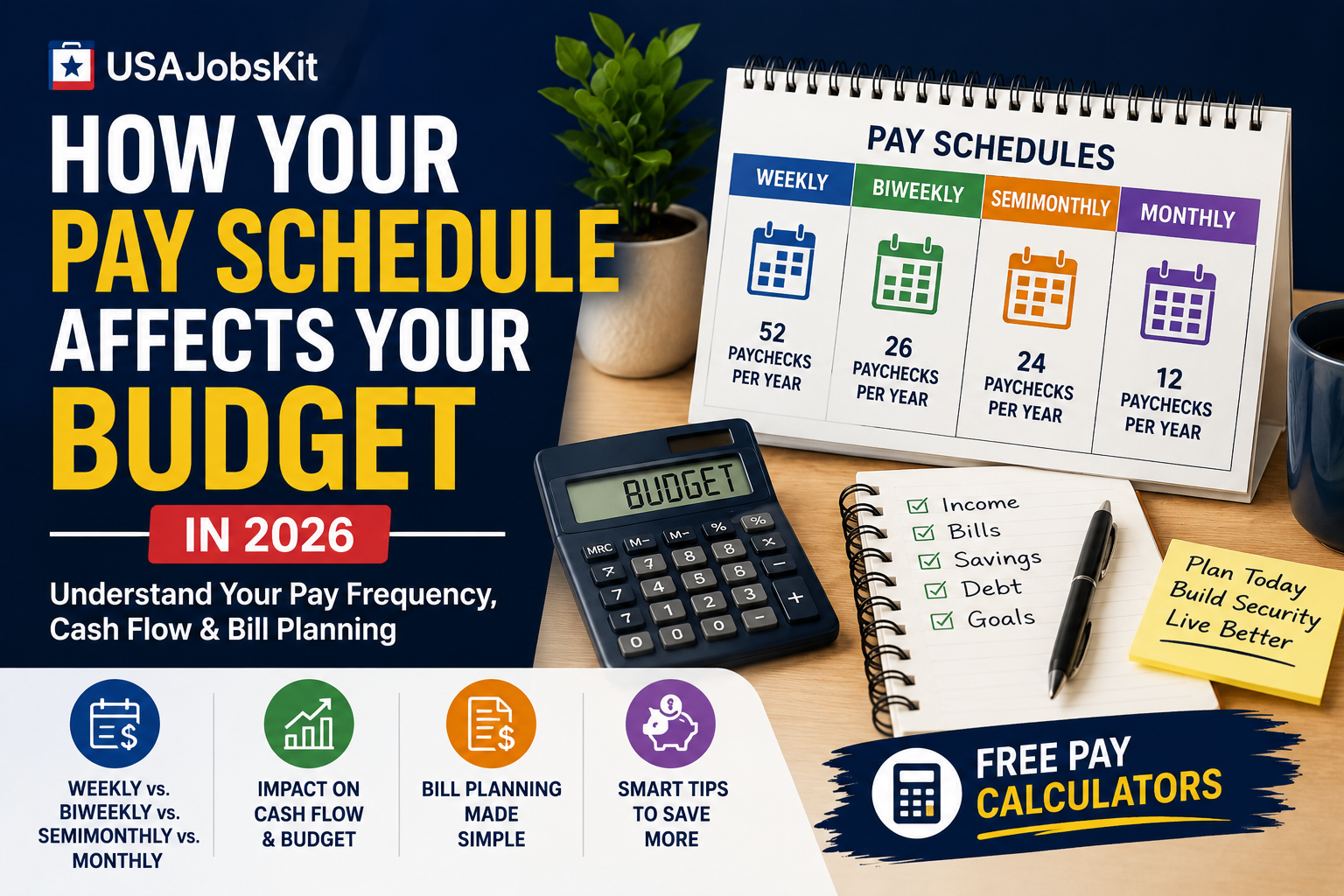
The four pay schedules used in the US
Most US employers use one of four pay frequency options. Each one creates a different number of paychecks per year, a different check size, and a different rhythm for managing money. Understanding your schedule is the starting point for any honest budget.
| Pay schedule | Paychecks per year | Pay dates | Common for |
|---|---|---|---|
| Weekly | 52 | Same day every week | Hourly, construction, trades |
| Biweekly | 26 | Every two weeks, same weekday | Most common overall in the US |
| Semimonthly | 24 | Fixed calendar dates (e.g. 1st and 15th) | Salaried office and professional roles |
| Monthly | 12 | One fixed date per month | Some government, executive, and contract roles |
Note that your annual gross pay stays the same regardless of pay frequency. A $72,000 salary is $72,000 whether you receive it in 12 checks or 52. What changes is how large each check is and how that timing lines up with your fixed expenses. For a quick conversion between schedules, the salary calculator breaks any annual salary into weekly, biweekly, semimonthly, and monthly amounts.
Weekly pay: frequent but smaller
Weekly pay means money arrives every seven days, giving you 52 paychecks per year. Each check is smaller than any other schedule, but the frequent cash flow makes it easier to cover short-cycle expenses like groceries, gas, and utility bills without waiting weeks for the next deposit.
The main budgeting challenge with weekly pay is that monthly bills – rent, car payments, insurance premiums – do not align neatly with seven-day cycles. A $1,400 monthly rent payment can feel awkward when your weekly check is $900 after taxes. The common fix is to treat four weekly checks as your monthly income and set the fifth check in longer months aside for savings or irregular expenses.
Weekly pay budgeting tip: Assign each week’s check to specific categories before it arrives. Week 1 for rent, week 2 for bills, week 3 for groceries and transport, week 4 for savings. Any extra check in a five-week month goes to a buffer fund first.
Biweekly pay: the most common schedule
Biweekly pay delivers a check every two weeks, totaling 26 paychecks per year. It is the most widely used pay schedule among US employers. Each check is roughly twice the size of a weekly check, which makes it easier to cover single large monthly bills from one deposit.
The budgeting quirk that trips people up is the three-paycheck month. Because 26 checks spread across 12 months does not divide evenly, two months per year will include three pay dates instead of two. Most workers spend that third check as though it were a bonus. A smarter move is to plan for it in advance and direct it toward savings, debt payoff, or a quarterly expense like car insurance or medical bills. The biweekly pay calculator can show you your exact per-check amount based on your salary or hourly rate.
Three-paycheck months in 2026: Identify them at the start of the year and mark them on your calendar. Deciding in advance what happens to that third check prevents it from disappearing into everyday spending.
Semimonthly pay: predictable but easy to confuse with biweekly
Semimonthly pay means two checks per month on fixed calendar dates, typically the 1st and 15th, or the 15th and last day of the month. That produces 24 paychecks per year – two fewer than biweekly, so each individual check is slightly larger.
The main advantage is predictability. Because your pay dates are tied to calendar dates rather than weekday cycles, your paycheck always lines up with the same part of the month. That makes it straightforward to assign the first check to rent and the second to utilities, subscriptions, and savings. The one friction point is that some months will have the 15th land on a weekend, which can shift the actual deposit date by a day or two depending on your bank and employer. Check the semimonthly pay calculator to see what each deposit should be for your salary.
Monthly pay: maximum discipline required
Monthly pay is the least common schedule for hourly workers but appears in some salaried, government, and contract positions. You receive one check per month, and that single deposit must cover 30 or 31 days of expenses. Each check is larger than any other schedule on a per-payment basis, which can feel comfortable in the first week.
The risk is cash flow timing. If rent is due on the 1st and your paycheck arrives on the 25th, you have roughly five days of buffer before a new billing cycle starts. An unexpected expense in week three of the month with no paycheck until week four creates real pressure. Workers on monthly pay generally need a standing cash buffer of at least one month’s fixed expenses to avoid that stress. To see your exact monthly take-home, the salary to monthly calculator gives a fast estimate.
Monthly pay rule: Treat your paycheck as arriving on the last day of the previous month, not the first day of the current one. That mental shift builds in the buffer automatically.
How pay schedule affects specific budget categories
Rent and housing
Rent is usually due on the 1st of the month regardless of your pay schedule. If you are paid biweekly or weekly, your check may arrive before or after the 1st depending on the year. Semimonthly workers paid on the 1st and 15th have the cleanest alignment. Everyone else benefits from keeping a dedicated rent pool rather than paying directly from whatever arrived most recently.
Irregular and quarterly expenses
Car registration, annual insurance premiums, and medical deductibles do not arrive monthly. Weekly and biweekly workers sometimes get caught because these costs fall outside the rhythm of regular budgeting. Setting aside a small fixed amount each paycheck into a dedicated irregular-expense fund prevents those bills from feeling like emergencies.
Savings contributions
Automating savings transfers to align with your pay date is one of the most reliable habits regardless of schedule. For biweekly workers, setting a fixed dollar transfer the day after each paycheck arrives means savings happen 26 times per year instead of 12. Over time, the difference compounds. If you are also contributing to a 401(k), the paycheck after 401(k) calculator shows how pre-tax retirement contributions change your per-check take-home under any pay frequency.
Debt payments
Credit card minimum payments are due monthly, but making biweekly half-payments instead of one monthly payment can reduce interest over time because of how daily interest accrues on most balances. This strategy works most naturally for biweekly workers since the payment rhythm already exists. For workers on monthly pay, scheduling the full payment a few days after the paycheck arrives removes the temptation to spend those funds first.
Budgeting by pay schedule: a practical comparison
| Pay schedule | Biggest budgeting strength | Biggest budgeting challenge | Best practice |
|---|---|---|---|
| Weekly | Frequent liquidity, easy to track short cycles | Monthly bills feel large relative to each check | Dedicate specific weeks to specific bill categories |
| Biweekly | Two checks usually cover all monthly bills | Third-paycheck months can disrupt spending habits | Pre-plan the third check at the start of each year |
| Semimonthly | Fixed dates make bill alignment straightforward | Weekend pay date shifts can delay deposits | Split fixed bills between the two monthly checks |
| Monthly | Largest individual check, simple math | Long cash gap, no room for mid-month surprises | Maintain a one-month cash buffer at all times |
USAJobsKit tools for every pay schedule
Before you can build a reliable budget, you need to know exactly what each paycheck will be after taxes and deductions – not just the gross amount. These tools give you those real numbers.
Pay Frequency Calculator
See how your salary breaks down across weekly, biweekly, semimonthly, and monthly schedules in one view.
Open the pay frequency calculatorPaycheck Calculator
Estimate your actual per-paycheck take-home after federal tax, state tax, and common deductions.
Open the paycheck calculatorBiweekly Pay Calculator
Find your exact biweekly gross pay from an annual salary or hourly rate.
Open the biweekly pay calculatorWeekly Pay Calculator
Convert your salary or hourly rate into a weekly gross pay figure for budgeting.
Open the weekly pay calculatorSalary to Monthly Calculator
See what your annual salary looks like as a monthly gross figure before deductions.
Open the monthly calculatorTake-Home Pay Calculator
Get a full estimate of your net pay after federal taxes, FICA, and state withholding.
Open the take-home pay calculatorRelated reading on USAJobsKit
- Biweekly vs weekly vs monthly pay – a deeper look at how each schedule compares for US workers
- Pay frequency guide – what different pay schedules mean and how to work with each one
- How to calculate take-home pay – step-by-step guide to estimating net pay from any salary
- How to read your paycheck stub – understand every line on your pay statement
- Beginner’s guide to US payroll taxes – what gets withheld and why
FAQ
Which pay schedule is best for budgeting?
It depends on your spending habits. Weekly pay gives the most frequent cash flow, which helps if you have lots of small recurring expenses. Semimonthly pay lines up well with monthly bills because you receive two predictable checks per month on fixed dates. Biweekly pay is the most common in the US and works well for most budgets once you plan for the occasional three-paycheck month.
Why does biweekly pay create a third paycheck in some months?
Biweekly pay means 26 paychecks per year across 12 months. Since most months have about 4.3 weeks, two months each year will fall so that you receive three paychecks instead of two. That third check is a good opportunity to build savings or pay down debt ahead of schedule rather than absorbing it into regular spending.
Does pay frequency change how much I take home overall?
Your annual take-home pay stays the same regardless of how often you are paid, assuming the same gross salary and withholding setup. Pay frequency only changes how that total is divided across the year. However, the size of each individual paycheck does change, which is what affects your ability to time bills and manage cash flow.
How should I budget if I am paid monthly?
With monthly pay, treat your paycheck as a single monthly pool and assign every expense category a portion immediately when the check arrives. Building a standing cash buffer of at least one month’s fixed costs is especially important because a 30-day gap between checks leaves almost no room if an unexpected expense hits mid-month.
What is the difference between biweekly and semimonthly pay?
Biweekly pay means you are paid every two weeks on the same weekday, producing 26 paychecks per year. Semimonthly pay means you are paid twice a month on fixed calendar dates, producing exactly 24 paychecks per year. Individual biweekly checks are slightly smaller because the same annual total is split across two more payments. For a full breakdown, the biweekly vs weekly vs monthly pay guide covers the differences in detail.
How do I find my exact per-paycheck amount?
The fastest way is to use a pay frequency or paycheck calculator that accounts for your gross salary, filing status, state, and deductions. That gives you a real after-tax number to build from. The pay frequency calculator and the paycheck calculator on USAJobsKit both work for any of the four common US pay schedules.
Sources
- Salarly – Understanding Different Pay Cycles: What They Mean for Your Budget
- Journal of Financial Economics – Does Paycheck Frequency Matter? Evidence from Micro Data
- Jobcase – 4 Most Common Types of Pay Schedules: Pros, Cons, and Budgeting Tips
Final takeaway
Your pay schedule is not just an HR detail. It determines the size of each deposit, when money is available relative to your bills, and how much planning discipline you need to stay financially steady. Understanding how your schedule works is the first step to making a budget that holds up month after month.
Start by knowing your real per-check take-home, not your gross salary. From there, every budget decision gets easier. Use the pay frequency calculator or the take-home pay calculator to get those numbers in under a minute.
Know your real paycheck number
Enter your salary and pay schedule to see exactly what lands in your account each pay period.
Disclaimer: This article is for general educational purposes only and does not provide financial, tax, or payroll advice. Pay schedules, withholding rules, and deposit timing can vary by employer, state, and individual circumstances. Always verify your specific pay details with your employer or payroll department.